It isn't often that I come across a documentary that hits so close to home for me by zeroing in on a subject I was once truly passionate about, whether we're talking space exploration, oceanography, paleontology, cartography, or, in this particular case, the electronic pop music of the early 1980s.
BBCFour's fascinating documentary Synth Britannia was, for me, a lot like watching a documentary about my own "musical awakening" in 1981 and 1982. Like pretty much every other kid in seventh and eighth grade, I listened to the local Top 40 station and let them relentlessly pound the hits of the era into my skull, but it was that exotic, impossibly perfect, alien-sounding electronic pop music that I could only find on MTV that held me completely rapt back then.
A year later, for a few incredible months, that same wonderful, mesmerizing music actually threatened to become the Top 40 in this country; a time that I will always remember as one of those mini "golden ages" when it seemed like mainstream radio could do no wrong (sadly, I don't think another one of these eras came along until 1990 or so). Synth Britannia covers that magical time period and the years that led up to it, tracking the rise of electronic music as a form of pop music from roughly 1977 to the middle of 1983.
Ever since watching that program, I've been stuck in a bit of a time warp as far as my home play list is concerned. The last two weeks in this office have been soundtracked by the best of the golden age of wireless; revisiting the early glories of Ultravox!, discovering the rich solo career of their forgotten original leader John Foxx, marveling anew at the recently remastered Kraftwerk catalog, taking another stab at Throbbing Gristle and Cabaret Voltaire (two challenging proto-electronic acts that I last sampled during my early 90s industrial phase) and playing through the entire Depeche Mode catalog while poring over the incredible Beatles Anthology-styled mini-movies packaged with their "collector's edition" releases that cumulatively chronicle their entire existence from 1991-2002 in incredibly revealing detail.
There were many joys and highlights to Synth Britannia, but perhaps the most striking part of the program was seeing these once unremittingly dour pop culture figures opening up a bit and showing that they didn't take themselves as completely seriously as, say, Sting does. OMD bassist and lead singer Andy McCluskey in particular was hilarious, while Human League singer Phil Oakey spins a good tale as well. Both figures offered plenty of pointed (and funny) insights into the electonic scene and their respective roles in it (with McCluskey getting a delicious parting shot at 90s Britpop at the very end). It was also interesting to hear deposed League synthesist Martyn Ware admit his jealousy at Gary Numan's "Cars" and discuss his motivations to challenge the his former band's chart supremacy with Heaven 17.
Now for the inevitable whining blogger complaints ...
The biggest problem with Synth Britannia is that, even at 90 minutes in length, you come away from the program a bit let down in the end since it seems to run full-tilt into a brick wall about 88 minutes in. I can understand and maybe even agree with Mr. Critic's point that the genre turned overtly commercial somewhere during 1983 (and the quick cut from that statement to poor Howard Jones dancing about with Jed The Dancing Mime was admittedly a hoot), yet it felt like a cop-out to end the program by saying "... and then things got really lame. The end." Regardless of what the producers may think of the Thompson Twins, I wanted more, and being told in effect that every synth-based act to come down the pike after the middle of 1983 was another load of bandwagoning crap struck me as irritatingly purist, especially when following the lionizing of Soft Cell, for crissakes.
I was also a wee bit irked that the Walter/Wendy Carlos' soundtrack to A Clockwork Orange seemed to be the lone early progenitor to synthpop, with no mention whatsoever given to David Bowie's Low (an album that, to me, is a far more obviously influential work). This omission becomes a bit more glaring when significant face time is slotted to Numan, whose twin genre classics Replicas and The Pleasure Principle owed an undeniable stylistic debt to Bowie's 1977 masterpiece.
Lastly, there is that inevitable list of bands that failed to make the cut. I'm sure this had much to do with time and budget constraints, but you also wonder if there was some unspoken lumping in of these missing artists with the post-1983 acts disparaged above. Was Thomas Dolby too commercial to count as true synthpop? Talk Talk? Visage? Pete Shelley? Blancmange?
My own geeky grumbings aside, Synth Britannia is definitely worth your time if you're into this kind of music. Here's hoping there will be some more in-depth examinations of this era in the future.
The videos linked throughout this post (and a lot more in the same spirit, including some very cool live BBC performances) can be found here.
Showing posts with label Music Industry. Show all posts
Showing posts with label Music Industry. Show all posts
Tuesday, November 03, 2009


Saturday, October 31, 2009
F.U.B.A.R. II: The Quickening
 As the much-hyped 9/9/09 street date for The Beatles box sets drew closer, our previously reported stock situation had not improved appreciably; our allotment for the mono box increased from 5 to 10 (after we had originally ordered 70), while our order for the stereo box (which we had also ordered 70 of) was going to be cut significantly. With this in mind, we started looking around for alternate external sources of stock the week before street date in a bid to back ourselves up as much as possible ... just in case.
Surprisingly, our rarely-used secondary supplier came through for us in a pinch; as with our primary supplier, their mono box set order had been brutally shortened by EMI, therefore getting additional copies was not going to happen. However, they were so well-stocked with stereo box sets that they were able to pull aside 15 pieces for immediate shipment right then and there. Greg took this news with a furrowed brow, stared off into space for a moment (as he always does when he's about to go out on a limb), then had me drastically increase our order to 50. Secondary supplier didn't even bat an eye as our order amount soared in an instant from $2700 to $9000; they must have somehow received a far better product fill than our primary source. Lucky bastards. I sometimes wonder if they regretted that sale afterward.
Greg and I had a long talk after placing the order, both of us wondering aloud if we had just jumped in over our heads; the stereo box would be retailing for $220 (give or take), after all, and adding 50 pieces of an item that expensive on top of the 35 we figured to be receiving from our main supplier seemed an almost suicidal move. What bothered Greg more was that we were also staring at a loss of at least half a grand in accrued returns, as we rarely buy enough from our secondary supplier to warrant returning anything, let alone 90-140 CDs worth of unsold product purchased from them. Still, we figured if nothing else that we could break these boxes down and sell off the individual albums if we wound up not selling them; it's the freaking Beatles, after all.
As it turned out, that backup order was one of most prescient calls of Greg's career; two days after securing those extra 50 copies of the stereo box from our backup source, we were informed by our primary supplier that our stereo box allotment had been dropped all the way to ten copies. Suddenly, those 50 box sets we'd ordered from California weren't a possible stone tied around our necks, but a lifesaver. I don't even want to think of what work would have been like over the next few weeks if we hadn't gone that route.
A lifelong poker player, Greg didn't show his hand when we were given this little update, and he raised some hell with our main supplier. His anger was only a partial bluff; both of us were pretty exasperated by now with the way this situation was changing on an almost daily basis and he let them know about it. To their credit, our ire was assuaged by the arrival of 11 additional copies of the stereo set over the next week from their "private stash." We also managed to get in on the ground floor when a second wave of mono box sets arrived at their warehouse just before release date. With an additional 41 copies of that limited set safely behind our counter (and dozens of individual titles on hand for those who didn't want to opt for the big sets), we were still short of our intended stock target as street date arrived, but at least we felt ready to do battle and kick some ass ... which is pretty much what we did.
Here's the really good news: after all of the unending headaches and scrambling about, these boxes proved very quickly to have been worth the chase. All of our efforts (coupled with the timely arrival of some big new releases over a three-week period) resulted in a sales bonanza the likes of which we hadn't seen here outside of Christmas season. Combined sales of the mono and stereo boxes (both in the store and online through our Amazon window) went beyond even our most optimistic expectations. Without getting into reams of boring numbers, let's just say that not only did the Beatles propel us to our best September sales figure to date, but they probably saved our entire year as well. Wooot!
A few weeks later, after all backup supplies on both sets had completely dried up (this has now been the case since early October), our primary sales rep informed us that we were the only account of theirs who had guessed right on these things; everyone else had run out days or weeks before and were screaming for additional product. While our salesman meant well with that statement, the fact that we had been right all along and yet still wound up on the short end of their supply stick (apparently thanks to a desire on their part to make as many accounts happy as possible by using the quantities that we had ordered to do so) made his flattery feel more like a poke in the eye. "Best laid plans" and all that rot ...
As of this writing, we are down to 1 copy of the mono set, having sold our last stereo box earlier this afternoon. As expected, EMI have gone back to the well for a second run of these "limited edition" sets, and we will hopefully have some new mono stock early next week (though our desired quantity is being cut down again as supplies are short of projected targets, ha ha ha). Unfortunately, we get to twist in the wind for a bit as far as the stereo set is concerned; no additional stock is expected until sometime around Thanksgiving. Ugh. For the sake of Christmas, I sure hope EMI can meet their maddeningly-shifting target date, because once you slip past that weekend with no product on the shelves, you are skating on awfully thin ice.
Wednesday, August 26, 2009
F.U.B.A.R.
"If this isn't the biggest bag-over-the-head, punch-in-the-face I ever got ... GOD DAMN IT!" - Clark Griswald
Really bad day at work today.
The most infuriating part of this whole mess was that we knew this was going to happen and we did everything we could to think ahead and attempt to circumvent this problem before it ever came up, yet we wound up getting screwed anyway. Unbelievably frustrating.
So, what happened, you ask? EMI happened. Yes, the worst record company on the planet is in the process of royally screwing up their biggest release of the year: the twin Beatles box sets, which are set to release on September 9. The ripple effects of this latest cock-up should pretty well sabotage the grand kick off to our fourth quarter, and torch what should have been our best weekend (and non-Christmas month) ever. To say we're "infuriated" is putting it nicely.
Here's the set-up: I'm not quite sure how much of this is ultimately tied into the general downsizing of the music industry apparatus over the last five years or so and how much was simple modern-day corporate thinking, but right now only two major labels, Sony and UMG, still own the means to press and distribute their own product. The remaining majors, WEA and EMI, long ago sold off their pressing plants and attendant pipeline outlets and now farm out these operations to outside companies (including Sony and UMG).
With sales levels being as depressed overall as they have been over the last few years, this new compacted production scheme runs relatively smoothly, only running into a bump here and there if an album suddenly explodes around Christmastime (Straight No Chaser) or if some unforeseen event has a drastic effect on sales (the entire Michael Jackson catalog going completely nuclear in the weeks following his death). Another cause of problems with this new system is the launch of items with bulky, complicated packaging like, say box sets.
As many of you I'm sure are aware, it's not the 1990s anymore, and CD boxed sets aren't the sales-driving juggernauts they once were. That said, once in a while you do get a long-awaited collection from a Neil Young or a Genesis (or, uh, the Beatles ... you know, the single biggest act of the entire rock era), that will create some noticeable sales ripples. With artists more involved than ever in the creation of these sets, and with label catalog departments all trying to create something with a unique design and multiple design-specific components to wow the people who still buy these things, the production of these sets requires significantly more effort (and, more importantly, time) to create than simply duping a couple hundred thousand Miley Cyrus discs and booklets.
The recent distribution history with nearly all box sets has not always been a pretty sight, and we've become used to these things almost immediately running into short supply. To ensure that we would be the only store that had any Beatles box sets in stock after everyone else had blitzed through their supply, we deliberately over-ordered, especially on the limited edition mono box (which would attract the most ardent Beatles fans who also happen to make up a sizable portion of our customer base). Thus, when the word came down a few days ago that there were production/supply issues cropping up with these sets, we didn't worry terribly much: we'd ordered enough that even if our initial order was cut (as we were pretty sure it would be), we'd still have plenty of stock to work with.
Well, we got word of our allotted amount from our supplier this afternoon and were very surprised indeed to learn that while we had ordered 70 mono box sets (by far the most of any account in our supplier's system), we would be receiving a grand total of 5. That's right: 5. I figure that amount should last us a whole two minutes from the time the box comes through our front door. Gosh, what a sales bonanza that will be.
Oh, it also turns out that our stereo box set orders will likely be slashed in half as well. Great. I guess a 50% fill beats the pants off of the 7% fill we're getting on the mono set, huh? Anyway, if this figure holds up, that would leave us with 35 pieces of the stereo set, which would then necessitate us having to buy up separate copies of all of the original albums as our strategy of sourcing the individual album sales from our planned glut of stereo box sets just flew out the window.
Looking into this disaster, it appears that some genius at EMI's sales department did his research and figured on a limited outlay of 13,000 copies for the mono set. This number was arrived at before any orders had even been placed, which is standard operating procedure for most labels as they can fine-tune their shipments upwards or downwards from target as orders come in during the solicitation period. Well, it turns out that this genius guessed a tad low: orders for the set topped off around 46,000, nearly 3.5 times the size of the intended production run. Oops.
Now, when this happens (which is hardly ever since most people in sales departments have at least a basic grasp of what the fuck they are selling), you generally have two options as a company: 1.) you delay the release of item a couple of weeks to allow for production to try and catch up to demand, or 2.) you stick with the release date and allocate shipments so that everyone gets something to sell, just not the quantities that they'd ordered. Locked into this September 9 street date since April 7 for crissakes, EMI felt they had no choice but to go with the latter option. A decision was then made to fulfill all the remaining orders before cutting the piece off once and for all. Thus, the mono set appears to still be limited ... to 46,000 units. At 270 bucks MSRP, one might figure that supply should last for a pretty good while. The stereo set, which is priced cheaper and actually has more CDs in it, will be available in perpetuity.
Of course, catching up to these remaining orders is going to take some time. Since they cannot press their own product, EMI has to stand in line along with everyone else, which means that retailers won't be seeing refreshed supplies of these sets for anywhere from 2-6 weeks after street date. In our discussions before we arrived at our order figure, I opined that these sets would get a pretty good second wind around Christmas time, but I didn't exactly figure on them being COMPLETELY GONE until then.
So, this is the way we sell things in the 21st century: set a release date months ahead of time, whip the media and the marketplace into a froth with wall-to-wall hype, and worry about whether you can actually meet said date sometime later on. Don't worry: by launch date, people will want to be the first to own your product so badly that it barely matters if you didn't make enough to go around or that there might be some mislabeled discs or perhaps a couple of packing errors during the assembly of the piece (whoops! I have an extra copy of Abbey Road instead of Yellow Submarine and my Please Please Me CD actually plays Rubber Soul instead!). This whole fiasco feels more like the launch of the Playstation 3 than something dreamt up by the music industry. Perhaps I miss the point when I wonder how this can be anything but a PR disaster, especially considering that the record industry has a vested interest in people buying their products, and this is generally helped greatly when that product is actually in stores when they say it's going to be.
Until today, we were really looking forward to these sets as there aren't many bands that create excitement amongst music people of all ages like The Beatles. Now, we're kind of dreading having to explain everything I wrote above time and time and time again. There are going to be a lot of very unhappy Beatle nerds running around on September 9 and the days afterward, and there aren't many things in customer service that are worse than dealing with unhappy nerds. Bravo, EMI.
Really bad day at work today.
The most infuriating part of this whole mess was that we knew this was going to happen and we did everything we could to think ahead and attempt to circumvent this problem before it ever came up, yet we wound up getting screwed anyway. Unbelievably frustrating.
So, what happened, you ask? EMI happened. Yes, the worst record company on the planet is in the process of royally screwing up their biggest release of the year: the twin Beatles box sets, which are set to release on September 9. The ripple effects of this latest cock-up should pretty well sabotage the grand kick off to our fourth quarter, and torch what should have been our best weekend (and non-Christmas month) ever. To say we're "infuriated" is putting it nicely.
Here's the set-up: I'm not quite sure how much of this is ultimately tied into the general downsizing of the music industry apparatus over the last five years or so and how much was simple modern-day corporate thinking, but right now only two major labels, Sony and UMG, still own the means to press and distribute their own product. The remaining majors, WEA and EMI, long ago sold off their pressing plants and attendant pipeline outlets and now farm out these operations to outside companies (including Sony and UMG).
With sales levels being as depressed overall as they have been over the last few years, this new compacted production scheme runs relatively smoothly, only running into a bump here and there if an album suddenly explodes around Christmastime (Straight No Chaser) or if some unforeseen event has a drastic effect on sales (the entire Michael Jackson catalog going completely nuclear in the weeks following his death). Another cause of problems with this new system is the launch of items with bulky, complicated packaging like, say box sets.
As many of you I'm sure are aware, it's not the 1990s anymore, and CD boxed sets aren't the sales-driving juggernauts they once were. That said, once in a while you do get a long-awaited collection from a Neil Young or a Genesis (or, uh, the Beatles ... you know, the single biggest act of the entire rock era), that will create some noticeable sales ripples. With artists more involved than ever in the creation of these sets, and with label catalog departments all trying to create something with a unique design and multiple design-specific components to wow the people who still buy these things, the production of these sets requires significantly more effort (and, more importantly, time) to create than simply duping a couple hundred thousand Miley Cyrus discs and booklets.
The recent distribution history with nearly all box sets has not always been a pretty sight, and we've become used to these things almost immediately running into short supply. To ensure that we would be the only store that had any Beatles box sets in stock after everyone else had blitzed through their supply, we deliberately over-ordered, especially on the limited edition mono box (which would attract the most ardent Beatles fans who also happen to make up a sizable portion of our customer base). Thus, when the word came down a few days ago that there were production/supply issues cropping up with these sets, we didn't worry terribly much: we'd ordered enough that even if our initial order was cut (as we were pretty sure it would be), we'd still have plenty of stock to work with.
Well, we got word of our allotted amount from our supplier this afternoon and were very surprised indeed to learn that while we had ordered 70 mono box sets (by far the most of any account in our supplier's system), we would be receiving a grand total of 5. That's right: 5. I figure that amount should last us a whole two minutes from the time the box comes through our front door. Gosh, what a sales bonanza that will be.
Oh, it also turns out that our stereo box set orders will likely be slashed in half as well. Great. I guess a 50% fill beats the pants off of the 7% fill we're getting on the mono set, huh? Anyway, if this figure holds up, that would leave us with 35 pieces of the stereo set, which would then necessitate us having to buy up separate copies of all of the original albums as our strategy of sourcing the individual album sales from our planned glut of stereo box sets just flew out the window.
Looking into this disaster, it appears that some genius at EMI's sales department did his research and figured on a limited outlay of 13,000 copies for the mono set. This number was arrived at before any orders had even been placed, which is standard operating procedure for most labels as they can fine-tune their shipments upwards or downwards from target as orders come in during the solicitation period. Well, it turns out that this genius guessed a tad low: orders for the set topped off around 46,000, nearly 3.5 times the size of the intended production run. Oops.
Now, when this happens (which is hardly ever since most people in sales departments have at least a basic grasp of what the fuck they are selling), you generally have two options as a company: 1.) you delay the release of item a couple of weeks to allow for production to try and catch up to demand, or 2.) you stick with the release date and allocate shipments so that everyone gets something to sell, just not the quantities that they'd ordered. Locked into this September 9 street date since April 7 for crissakes, EMI felt they had no choice but to go with the latter option. A decision was then made to fulfill all the remaining orders before cutting the piece off once and for all. Thus, the mono set appears to still be limited ... to 46,000 units. At 270 bucks MSRP, one might figure that supply should last for a pretty good while. The stereo set, which is priced cheaper and actually has more CDs in it, will be available in perpetuity.
Of course, catching up to these remaining orders is going to take some time. Since they cannot press their own product, EMI has to stand in line along with everyone else, which means that retailers won't be seeing refreshed supplies of these sets for anywhere from 2-6 weeks after street date. In our discussions before we arrived at our order figure, I opined that these sets would get a pretty good second wind around Christmas time, but I didn't exactly figure on them being COMPLETELY GONE until then.
So, this is the way we sell things in the 21st century: set a release date months ahead of time, whip the media and the marketplace into a froth with wall-to-wall hype, and worry about whether you can actually meet said date sometime later on. Don't worry: by launch date, people will want to be the first to own your product so badly that it barely matters if you didn't make enough to go around or that there might be some mislabeled discs or perhaps a couple of packing errors during the assembly of the piece (whoops! I have an extra copy of Abbey Road instead of Yellow Submarine and my Please Please Me CD actually plays Rubber Soul instead!). This whole fiasco feels more like the launch of the Playstation 3 than something dreamt up by the music industry. Perhaps I miss the point when I wonder how this can be anything but a PR disaster, especially considering that the record industry has a vested interest in people buying their products, and this is generally helped greatly when that product is actually in stores when they say it's going to be.
Until today, we were really looking forward to these sets as there aren't many bands that create excitement amongst music people of all ages like The Beatles. Now, we're kind of dreading having to explain everything I wrote above time and time and time again. There are going to be a lot of very unhappy Beatle nerds running around on September 9 and the days afterward, and there aren't many things in customer service that are worse than dealing with unhappy nerds. Bravo, EMI.
Monday, June 01, 2009
In Defence Of Compact Discs
The bed-headed 15-year-old slaps down a battle-scarred copy of Pink Floyd's Dark Side of the Moon rescued from the 99-cent bin. I prepare to engage in the oft-repeated litany about the “warmth” of vinyl and how it's closer to how the ear hears than anything digital, etc. etc. etc.
But then he follows up with, “I really like all the ticks and pops.”
A blog post (linked in the post title) I can certainly identify with from a fellow record store lifer in the midst of the early twenty-first century vinyl resurgence who is perfectly happy with his CD collection, thankyouverymuch.
Monday, March 30, 2009
Truly "Bigger Than Jesus"
 No discussion of popular music in the 1960s (or the 20th Century, for that matter) could be complete without mention of The Beatles, and this week marks the 45th anniversary of what could arguably be considered the very height of Beatlemania.
On Billboard's Hot 100 singles chart for the week ending April 4, 1964, the Fab Four achieved a level of dominance never seen before or since as they staked claim to the Top 5 positions on said chart, while placing an incredible seven other songs ("I Saw Her Standing There," "You Can't Do That," "All My Loving," "Roll Over Beethoven," "From Me To You," "Do You Want To Know A Secret," and "Thank You Girl") at various slots down the list.
Below is a look at that week's Top 10 as it was published:
 As you might have noticed, the Beatles singles listed above originated from multiple distributors, not just Capitol Records (the label they had signed to just before the hysteria had started, and their U.S. home ever since). Facing a stone wall of skepticism or outright hostility from the U.S. record industry, band manager Brian Epstein had scattered several Beatles singles among a handful of smaller independent labels over the second half of 1963 in persistent efforts to get a foothold in the U.S. market with no success at all. Then, as now, if you had an insufficient promotional budget to spend fostering radio airplay, your releases simply would not get on the air, and the labels that chose to work with Epstein had little or no national promotion budget to speak of.
Epstein's efforts at the time may have been viewed as a failure, yet they paid off wildly when the band became a known entity in America seemingly overnight. Thus, when "I Want To Hold Your Hand" went supernova in January of 1964 (with five million sold, it ultimately became the best-selling song of the decade), there was plenty of older Beatles product available to record stores who found themselves swamped by overwhelming demand for anything Beatles-related. Such was this demand that even cash-in novelty records recorded in the days and weeks following the band's Ed Sullivan Show appearance began to show up in the record charts as well in the form of "We Love You Beatles" by The Carefrees, "A Letter To The Beatles" by The Four Preps, "My Boyfriend Got A Beatle Haircut" by Donna Lynn and "The Boy With The Beatle Hair" by The Swans.
While managing to nail down the Top 5 slots on the Hot 100 is an impressive enough feat, one has to look beyond this amazing one-week snapshot to see just how stupendous the Beatles were in the first half of 1964. While they released their most epochal works down the line a ways, they would never again completely dominate culture like they did that spring. For starters, that mind-boggling roll call of twelve singles listed simultaneously on the Hot 100 would actually increase to an unbelievable fourteen entries on the April 11 chart as "There's A Place" and "Love Me Do" entered the fray alongside their dozen predecessors.
The April 4 chart may have been the only time the Beatles would control the entire Top 5, but their domination of the Billboard singles chart extends for months either way: on April 4, the band had now owned the entire top 4 for two straight weeks and the entire top 3 for four straight weeks (since March 14). If that wasn't enough of a stranglehold for you, consider next that the Fabs had also reserved the top 2 positions on the Hot 100 from February 22 to April 25 (1o weeks) and held down the number 1 spot with one song or another from February 1 though May 2 (14 weeks).
Oh, it gets better: The Beatles kept at least one song in Billboard's Top 10 from to January 25 to June 20 of that year (22 weeks solid), and managed to keep at least one hit in the national Top 40 for 39 consecutive weeks -- from January 25 (the week "I Want To Hold Your Hand" rocketed from #45 clear up to #3) all the way through to October 17 (the week "Matchbox" tumbled from #17 to #52, opening a nearly two-month period when no Beatles songs impacted the U.S. Top 40 ).
Lastly, and perhaps most incredibly of all, by the end of 1964, the Fab Four would amass 15 million-selling records in the U.S. (over 9 singles and 6 albums), and the total sales of these releases combined amounted to over 25 million records sold ... by one band in one year.
Monday, November 24, 2008
Universal To Charge For Viewing Online Music Video?
While perusing headlines on Billboard.com earlier this morning after a cleaning appointment with my dentist, I came across an interview with Interscope Records chairman Jimmy Iovine earlier, mostly concerning the decisions made to delay some of the label's biggest expected fourth quarter hit albums into 2009 (as if the music industry needed any more woes).
Other topics were briefly touched on as well, including the increasing trend of major labels/acts offering their new releases exclusively to such big boxes as Wal-Mart and Best Buy, and this interesting little nugget:
Sooo help me out, here: does Iovine honestly think Soulja Boy would have had 500 million views if he charged, say, a buck a view for his video clip? How about Lady GaGa? Or how about those 3 billion views for Universal artists on Youtube? Am I over-reacting or is this the absolute nuttiest thing I have heard from the music industry this year?
Jesus, you guys can't even do catalog reissues right anymore without somebody fucking something up and now you want to start charging people to watch promotional videos that were made exclusively to sell your records and mp3s?
Sorry, MTV, looks like your cool new venture might crash before it ever achieves full flight.
Other topics were briefly touched on as well, including the increasing trend of major labels/acts offering their new releases exclusively to such big boxes as Wal-Mart and Best Buy, and this interesting little nugget:
I've always felt, and this is just in general, that there's an oil well for the record industry in their music videos, and so does Doug Morris. Universal Music Group had 3 billion views on YouTube and we are so underpaid for those videos. Now, we'll set up an infrastructure, and Doug's in charge of this. We'll make a deal where we really see the value. We have the most perfect content for the Internet. People love to watch them and they watch them over and over again. If Saturday Night Live gets 100,000 views on the Internet, they throw a party. Soulja Boy, on his site alone, got 500 million! It's nuts. The Lady GaGa video has 25 million views.
This is all going to be turned back toward the labels. That value has to be achieved.
Sooo help me out, here: does Iovine honestly think Soulja Boy would have had 500 million views if he charged, say, a buck a view for his video clip? How about Lady GaGa? Or how about those 3 billion views for Universal artists on Youtube? Am I over-reacting or is this the absolute nuttiest thing I have heard from the music industry this year?
Jesus, you guys can't even do catalog reissues right anymore without somebody fucking something up and now you want to start charging people to watch promotional videos that were made exclusively to sell your records and mp3s?
Sorry, MTV, looks like your cool new venture might crash before it ever achieves full flight.
Friday, November 21, 2008
The Comedy Of Errors Continues

It's bad enough for the music industry's long-term health (assuming such a concept still exists) that an ever-decreasing number of people are buying CDs in ever-decreasing amounts, but when record companies seemingly go out of their way to piss off the remaining people who are still actually paying for physical product, you have to wonder sometimes at the point of it all.
The breaking New Order reissue debacle is only the latest in a series of self-inflicted PR black-eyes suffered by what's left of the Big Four distributors over the last few years. What is particularly disturbing in this instance is that the company at fault here is the once-mighty Rhino Records, who were at one time considered the best reissue label on the planet, with a reputation for sonic and packaging excellence recognized by consumers and retailers alike. Granted, the brain trust that made the label great has long since bolted the coop, but for this same label to not only release such a shoddily-created product with no input whatsoever from the band itself is one thing, but to then go ahead and release it in the United States (despite numerous complaints had already surfaced overseas) and then not even acknowledge that there is any problem until most die-hard fans have already impatiently snapped up their copies is simply inexcusable. In effect, what we have here is yet another example of labels seeking to squeeze maximum profits wherever possible while whittling down manpower and tossing previously trumpeted standards of quality and worksmanship right out the window.
It's bad enough that we're being conditioned as a society to accept slapdash plastic doo-dads rushed to market to meet quarterly expectations for their parent multinationals (how often do we pick up buggy cell phones and video game systems that don't always work correctly and accept this crap in order to be among the first to own them), but now this cynical attitude is spreading to "deluxe" reissues of 25 year old records, as well. With catalog departments being systematically pared down to skeleton crews, the job of researching and remastering old recordings has become far more of a major undertaking than it was in headier times, and time-saving shortcuts such as using sub-par quality LP-pressing masters or even vinyl records themselves as source material have become a more common practice as of late, particularly in Europe.

Another victim of this new corporate reality is the hatchet job done by EMI on the Pink Floyd box set Oh, By The Way last Christmas. What was already shaky idea to begin with ("Hey, let's put every Pink Floyd CD ever made -- not including any live albums, bonus tracks, singles or non-album cuts -- into a super-expensive, but cheaply made cardboard box and then market it to people who already own all the albums!"), was made far worse when thousands of irritated customers began reporting mis-printed CDs ("Hey! Why does Wish You Were Here suddenly sound exactly like Obscured By Clouds?"), doubled-up CDs ("Hey! I have two copies of Ummagumma, Disc 1!") , or even completely-wrong pressings ("Hey! This isn't Pink Floyd at all!"). For a list price of $299.99, you might think that some level of quality control was observed somewhere along the production line, but apparently even that is too much to expect these days. Silly us.
Perhaps the worst industry practice that is making even hardened music dorks such as I think twice about plunking down money for new CDs is the ongoing race to create the loudest, most unlistenable CDs possible. There was an infamous quote in Rolling Stone magazine a couple of years ago from no less than Bob Dylan that summed up the state of the art in music in no uncertain terms: "(modern albums) have sound all over them. There's no definition of nothing, no vocal, no nothing, just like ... static."
While it's certainly debatable at what point the loudness wars started in the 1990s, it was The Beatles who initially set the bar for increased volume in 1986 when their early catalog appeared on CD for the first time, with all of their discs mastered nearly twice as loud as any other rock titles on the market.
 It took a few years for modern rock to catch on, but it started to happen around 1992-1994, when albums by Metallica, , Nirvana, Nine Inch Nails, Stone Temple Pilots, and Alice In Chains seemed to leap forth from speakers with real, tangible ferocity, especially when compared to the rest of the market at the time. Of course, many of their competitors (or the heads of their labels) heard these records and then asked their producers and engineers why they couldn't make records that sounded just as loud (if not more so) as Metallica, In Utero, The Downward Spiral, Core, or Dirt did, and the race was on.
 It took a few years for modern rock to catch on, but it started to happen around 1992-1994, when albums by Metallica, , Nirvana, Nine Inch Nails, Stone Temple Pilots, and Alice In Chains seemed to leap forth from speakers with real, tangible ferocity, especially when compared to the rest of the market at the time. Of course, many of their competitors (or the heads of their labels) heard these records and then asked their producers and engineers why they couldn't make records that sounded just as loud (if not more so) as Metallica, In Utero, The Downward Spiral, Core, or Dirt did, and the race was on.
It was also right around this time that the first "remastered" CDs started to appear in record stores. The argument for the existence of these refurbished albums was that either a.) many CDs of older albums were initially rushed to market in the mid 1980s with little regard to making sure that the original master tapes had been sourced for optimum sound quality (hmm, sound familiar?) or b.) advances in sound reproduction technology since 1983 had made it possible for CDs to sound even "better" than before as a "warmer," more analog-feeling ambience of sound was now becoming possible.
I would be remiss not to mention that the real point to this wave of upgraded classics was, of course, to force die-hard fans to buy their favorite CDs all over again (which some maintain was the true reason for all of this in the first place). Now, it would have been fine and dandy to remaster these older albums once and then let the upgraded, "corrected" copies stand at that, but some records have been now been reissued and remastered multiple times, with differences in sonic quality and mastering on each different iteration. This practice certainly gives credence to those who feel that all of this is just a way to part fools from their money one more time, especially as these same records get progressively shittier sounding with every new appearance on the market.
I had been aware of this loudness war for years, especially since I used to make mix tapes for myself and my friends constantly, and learned early on what recording levels certain CDs from which time periods or musical genres needed to be set at for the best sound quality (and smoothest listening experience) on a finished TDK SA-90 cassette. My frustration with wildly varying levels of output (try making a full-career hits mix tape sourced from old and new Bruce Springsteen CDs to get an idea of where I'm coming from) had me solidly in the "remaster everything!" corner for years, and the first instance where I can recall a new record being "brick-walled" to the point of distraction was Oasis' 1997 release Be Here Now: though I wrote off a lot of my displeasure with that record at the time as being subpar writing and mixing more than anything else. After all, this was the same summer that Radiohead's similarly-mastered classic O.K. Computer had taken over the world, and that record was just great, thank you very much.
 My first real animosity against this practice of level compression and peak-limiting came along five years later, when Rush released their absolutely unlistenable reunion album Vapor Trails. After years of earth-shaking build up from sundry rock and pop acts across the spectrum, here at last was a record that was so invasively and unbelievably shrill that it wasn't so much a "listening experience" as a buzz saw to the forehead.
These days, CDs with no dynamic range whatsoever are commonplace, especially at the major label level (indies either can't afford the software, or somehow just know better). Some of the blame is certainly attainable to the race to be as loud as the competition, yet other factors like a sea change in listening habits amongst music buyers away from expensive rack stereo systems and towards iPods, cell phones, and tiny PC speakers also have done their part to alter the way music is presented. While many consumers don't really seem to care that they no longer need volume knobs on their car stereos, enough have banded together in online communities that a whole secondary market of people actively searching out, say, older editions of Led Zeppelin and Genesis CDs has emerged in the underground, claiming that these CDs were actually done right the first time around and have only been marred by any remastering done since the mid-late 1980s. Even younger music fans have noticed recently how much better the video game version of Metallica's Death Magnetic sounds than the actual CD (a graphical comparison can be seen here).
Perhaps the most darkly amusing (nevermind ironic) side effect of these shenanigans is that a new generation of music buyers have embraced the once-comatose format of vinyl LP records as a superior alternative to compact discs. Once they realized what was happening, labels cynically began cashing in: even going so far as to issue record bags emblazoned with their laughable new catch phrase "because sound matters."
The best part? Out of this vinyl resurgence comes a new ridiculous extreme embodied by the bonus CD packaged with vinyl copies of Lindsey Buckingham's new album Gift Of Screws. Now, the idea of throwing in a "bonus" CD copy of a release with the vinyl LP is a nice idea, sure, but the sticker on this album proudly proclaims:
Perhaps the most darkly amusing (nevermind ironic) side effect of these shenanigans is that a new generation of music buyers have embraced the once-comatose format of vinyl LP records as a superior alternative to compact discs. Once they realized what was happening, labels cynically began cashing in: even going so far as to issue record bags emblazoned with their laughable new catch phrase "because sound matters."
The best part? Out of this vinyl resurgence comes a new ridiculous extreme embodied by the bonus CD packaged with vinyl copies of Lindsey Buckingham's new album Gift Of Screws. Now, the idea of throwing in a "bonus" CD copy of a release with the vinyl LP is a nice idea, sure, but the sticker on this album proudly proclaims:
180 GRAM VINYL + AUDIOPHILE CD
RECORDED MIXED & MASTERED ON ANALOG TAPE. INCLUDES CD OF THE UNCOMPRESSED VINYL MASTER PLATING & PRESSING AT R.T.I.
What the hell? I've heard many times before the old argument that vinyl sounds better than CD, but this is something new. If I am reading this correctly, Warner Bros, Records is now implictly admitting that modern mass-marketed CDs sound like dog shit. Even if you think this reaction is over the line, doesn't the very existence of a specialized "audiophile" pressing (available only when you buy the vinyl copy, no less! ha ha!) make you wonder what the hell the regular version is supposed to be?
One funny thing about modern "brick-walled" CDs: they make average bit rate-quality mp3s sound even worse than they already do (as if that were possible). We used to joke at work that the sudden leap in CD volume across the board in the last decade was actually a deliberate and subtle sabotaging of the mp3 format by the major labels, but in light of recent events, it appears that is giving the suits far too much credit.
Friday, October 10, 2008
Chinese Democracy Is Finally At Hand
Billboard's Jonathan Cohen is reporting the release of the fifteen-years-in-the-making Guns N' Roses album Chinese Democracy, which will (of course) only be available through everyone's favorite neighborhood record store, Best Buy. Oh goody.
The set ... will be available Sunday, November 23, rather than the usual Tuesday.
Gosh, how clever and daring, Axl. Nice to have you back. I hope your shitty new record tanks.
This spring, soft drink manufacturer Dr Pepper offered to send a free can of the beverage to "everyone in America" (excluding ex-GNR members Slash and Buckethead) if "Chinese Democracy" were to arrive anytime during the calendar year 2008. A Dr Pepper spokesperson was not immediately available for comment.
Crap. Dr. Pepper? Ewww. Can I ask for a Pepsi or Mountain Dew instead?
The set ... will be available Sunday, November 23, rather than the usual Tuesday.
Gosh, how clever and daring, Axl. Nice to have you back. I hope your shitty new record tanks.
This spring, soft drink manufacturer Dr Pepper offered to send a free can of the beverage to "everyone in America" (excluding ex-GNR members Slash and Buckethead) if "Chinese Democracy" were to arrive anytime during the calendar year 2008. A Dr Pepper spokesperson was not immediately available for comment.
Crap. Dr. Pepper? Ewww. Can I ask for a Pepsi or Mountain Dew instead?
Sunday, June 29, 2008
(Twenty Years) Part 16: Still In The Game

In 2001, the fortunes of the newly formed Walrus Music briefly mirrored those of the industry at large, though for very different reasons. Overall, our sales were doing fine, but the enforced removal of our most profitable area of business wound up derailing the year. Luckily, we managed to make up all of our lost momentum the following year and have been trucking ahead at varying speeds ever since. The music industry as a whole, however, was now starting to feel the first real pangs from widespread P2P downloading as yearly sales began to tumble from the stratospheric heights they had reached in 2000.
While there was a lot of worrying going on at the distribution level, the overall tone of discussion back then was still more hypothetical/"what if" than bleak or despairing. Since the real bad times had yet to arrive, a lot of people initially refused to believe that the sky was truly falling, instead maintaining that this drop in sales was some kind of brief contraction or correction, and everything would be dandy again as soon as people stopped sharing mp3s and were somehow forced to buy them instead. It would take the realities of the next three years to kill that line of thinking dead once and for all.
Somehow, while the music business declined over the ensuing years, Record Den's sales not only grew, but flourished. Even now, I'm not sure I can fully explain why this was the case, but I can offer up a few ideas that might solve the equation when added together ...
1. Adults
The fact that we are still open certainly doesn't mean that downloading had no impact on our business: of course it did, but we were, I think, able to trade off clientèles before the damage got out of control. Over the years, kids had noticeably vanished from our customer mix while we started seeing more and more new customers over the age of 30 instead, many of them driving in from the other side of Cleveland or points south to patronize our store. To reflect this shift, we started to alter the store's selection slightly away from an indie-rock intensive mix into something far more classic/progressive leaning in nature, while still seeking to retain the loyalties of the few teenagers who still believed in buying music as an actual physical product rather than simply hoovering it down by the gigabyte from a file sharing service.
2. Catalog
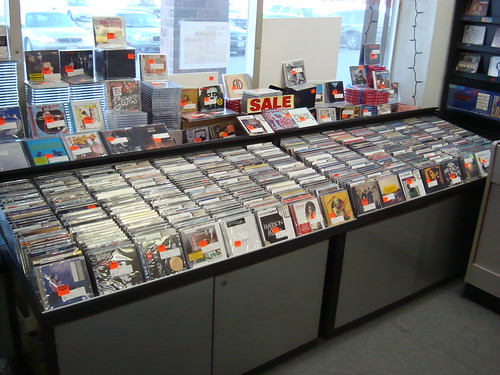
Meanwhile, after years of successfully attempting to smother competition by maintaining a massive inventory of music, the big boxes were beginning to scale back on CD floorspace in favor of DVDs, which were still a red-hot commodity. The once-impressive rows of CDs Best Buy used to boast suddenly started looking rather thin as they were now prioritizing guaranteed hit music over "marginal" catalog or independent releases/reissues. Sure, you could walk down an aisle there and see a truly massive U2 section sporting about 150 CDs, but upon closer inspection you'd realize that 130 of those CDs were copies of How To Dismantle An Atomic Bomb with a couple copies each of 4 or 5 other titles sprinkled about for appearances sake.
This restructuring of priorities at the big boxes created an opening for us, and we charged straight into it. The Den started attracting people who had grown up with rock music and weren't quite ready to let go just yet. If we were going to keep them coming back, we were going to have to retain far more deep catalog than we ever had before, and we started adjusting our buying accordingly. Luckily, the major labels had started offering substantial discounts on their catalog in order to keep it moving outside of the big boxes, and Greg jumped feet-first into these buying programs, snapping up thousands of older CDs at reduced rates and passing the savings along to stimulate sales. We had always done a pretty good job with keeping some special, hard-to-find titles of local interest handy for whoever asked, but now we were actively cultivating a reputation as the place to get anything you hadn't heard in a quarter century or more.
Once we had the ability to buy direct from two of the biggest music companies in the world, it seemed like this end of the business really started to get rolling for us. I cannot stress enough how being able to buy directly from two of the biggest music distributors has greatly increased our ability to compete with big boxes since the catalog discount programs offered at the distributor level were far better than any one-stop could offer. For a year or so, our sale bins at the front of the store could have been called "The WMG Bins" as product from that distributor overwhelmed all else. When we got Universal opened up a year or so past that, the buying balance shifted again, and we now have what looks like a mini warehouse in the back room jammed solid with CDs from WEA and Universal. These programs, coupled with an explosion in cheaper old import titles, began to transmogrify our store into a kind of classic rock heaven on Earth.

3. Vinyl
Another factor in our longevity has been the completely unexpected re-emergence of vinyl (whether used or new) as a collectible format. Aside from dance and hip-hop 12" singles and the odd Pearl Jam LP, we had been pretty much out of the vinyl market from 1990 through the end of our days in the Great Lakes Mall. We hadn't had any plans to re-enter that market in our new location until a few months after re-opening, when a customer asked us one afternoon if we carried any vinyl records. Greg and I both shook our heads no, and when the customer then asked us why, neither of us could come up with a good answer.
With space to burn (and no better ideas to try out), we started buying and selling used LPs again for the first time in a decade. Initially, almost everything we set out to sell was priced at a dollar, with a few premium pieces going as high as five. Sales were steady, but slow, and as more people got wind of the fact that we'd take their old boxed-up records off their hands, our stock began to outgrow the bins we'd set aside to contain it. For some time, this became a concern, especially as we began stockpiling everyone's grandmother's record collections in boxes piled six feet high in the back room while the vinyl bins overflowed and spilled onto the floor. There were times when it was getting so crowded in the back that we were seriously considering shutting off all vinyl buying in an attempt to keep our stock under control, and that is when we started running into the E-bay people: the guys who earn a living buying crates of stuff at rock-bottom prices from anybody who would sell it to them and then finding people online who would pay them for whatever goodies they might come across.
At first, we were amused (and relieved) when the E-bay people would show up and cart off boxes of moldering records at a time, but it became apparent over time that LPs could become a valuable part of our profit margin, and we started becoming a bit more hands-on in the pricing and buying of used vinyl instead of simply buying everything in at a flat rate and blowing it out the door ASAP. While we still occasionally buy "by the pound" if a customer doesn't feel like going store-to-store looking for a better deal, we now have a pretty decent idea which records are worth paying more for (almost any band or act we've never heard of before) and, more importantly, which ones aren't (pretty much every album released on Columbia between 1973-1987).
These days, used vinyl sits in every open nook and cranny in the store, with the premium titles arranged semi-alphabetically in specially made bins in the back while everything else is boxed up or lined up wherever we can find room. Quite frankly, we need a better way to display our vinyl stock: sales have picked up in intensity to the extent that used LPs now regularly out-sell used CDs on a piece-count and dollar basis,and our used CDs are far easier to browse than our vinyl. Also, the profit we are able to realize from selling used vinyl has been instrumental in keeping us afloat and amending for the relatively thin margin afforded by contemporary CDs, thus we definitely owe it to ourselves to come up with some kind of new solution to displaying the hottest selling items in the store.
Now comes the weirdest part: over the last two years, used vinyl has started to bring back a good chunk of the younger customers we figured had been lost for good to downloading. Somehow, a lot of younger people have glommed onto vinyl being a more immersive, meaningful, and (let's not kid ourselves) hip listening experience than an mp3, and they have embraced the format to a mind-boggling extent, whether used or new. Where we once spent most of our time with visiting sales reps screaming about CD prices and crappy marketing ideas, now we're always pleading with them to get as much classic rock vinyl into the marketplace as quickly as possible, because we sell it faster than we can keep up with it.

For the first time since opening up at our current location, I think we've achieved the kind of store we'd always imagined we could run back in the old days when a slow afternoon could be spent blue-skying a Deak-free existence in the now-museum like expanse of Great Lakes Mall. We are all very proud of what Record Den has become and also hoping we can keep it going at full steam even as the U.S. economy goes to Hell in a hand basket all around us.
While the plan is to keep going as long as we can, the near future remains a bit hazy as I write this: our lease comes up next year, and preliminary negotiations between Greg and our corporate landlords have deadlocked over rent (they want to raise it over time, he wants a constant rate in exchange for a longer lease). For the time being, we're letting the landlords stew for a while as time is presently on our side: the longer we wait, the better idea we'll get of where we're going in a financial sense. Already lagging behind the pace of a flat 2007, we are now facing what could be a brutal summer, what with gas prices at 4 dollars a gallon (and the price of oil continuing to climb, dragging behind it the cost of just about everything else in existence) and the entertainment dollar being stretched tighter than perhaps at any point in the last thirty years. We're working just to keep ourselves respectably close to our target figures, but this has not been a banner year thus far.
What happens this summer (not to mention over the following Christmas) will impact any long range plans Greg comes up with between now and then. It's hard to guess what to expect, but I would be very surprised if Greg opts to stick in a fork in this operation next year, largely because we have an awful lot of inventory to sell, and barring the launch of a full-time internet operation, I can't imagine what the hell we'd do with all of this stuff should our day of reckoning come earlier than expected.
My feeling is that we'll end up renewing our lease on a year-to-year basis and keeping our options open. As long as people remain willing to buy music on a physical format in a retail environment, Greg will want to be open to provide that service. He has said many times in the past that he was playing to be the last man standing at local indie music retail, and you can certainly argue that he got his wish. I hope this doesn't sound like we're gloating, because we both miss the days of friendly competition and being able to visit places like Record Revolution, My Generation, Platterpuss, or Repeat The Beat: discovering cool imports and underground releases we'd never seen or heard before. This was part of the fun of working in this business, and most of it is now long gone. Sure, we're very happy to still have our doors open, but it's kind of a drag on a personal level when the nearest store that even remotely resembles our own is nearly 50 miles away.
While the business side is pretty much up to Greg, there is also a possible decision to be made on my end as well. While being a Den lifer thus far has brought a measure of reassuring stability to my life, I'd be lying if I didn't admit that I have stretches of dealing with John Q. Public that make me wonder how much longer I want to keep on doing this, (especially if we do wind up getting a multi-year lease offer to stick). After years of always taking the money instead of some time off, a vacation at last looks like a reality for me, and that might be enough to "reset" and refresh myself for a bit and simply get away from the grind. If it sounds waspish and antisocial to say that I need a break from being around people, then so be it. The status of Sarah's education and job will also weigh in on my decision, particularly if she feels that better opportunities are lying in wait outside of Ohio.
Certainly, there will be much dwelling, discussion and consideration as the end of this year draws close, but the one implacable constant lying at the bottom of all of this is the simple fact that I still love my job and the idea of dropping it on my own accord in lieu of an occupation that I don't love is a rather daunting prospect, to say the least.

Sunday, June 08, 2008
(Twenty Years) Part 15: Raid
 The once-booming market in live bootleg CDs had been in flux for some time in early 2001. In the years following the enforcement of GATT, finding workable sources for these illicit titles was like playing a game of Whack-A-Mole (for us as well as the authorities). Also, as good titles became harder to locate, the packaging standards had started to head down the tubes, both in terms of the once-ornate booklets and cover art as well as the source music, which was occasionally being sourced not from original show tapes but from compressed digital files grabbed right off of the internet.
Granted, these were bootleggers we were dealing with and not, say, Mobile Fidelity Sound Lab, so there wasn't an awful lot you could say when you got a dozen copies of a Metallica concert burned onto a generic CD-R with paper artwork straight out of a cheap PC printer and the songs all separated by a second or two of silence (since the manufacturers not only used mp3 files, but couldn't even be bothered to burn the stupid shows using Disc-At-Once). It's not like these things were sold on any kind of returnable or guaranteed basis, either: once you bought 'em, they were yours forever. For the first time since we'd started buying them in the late 80s, the problems of carrying bootlegs were starting to outweigh the benefits.
Around the end of 2000, we had found a new and local source for boots, and we'd get our orders from this guy quite literally in pieces: that is, CDs in one box, artwork and jewel cases in another. It wasn't a ton of fun standing there behind the counter and putting these things together for hours on end, but I guess it beat shrink-wrapping stacks of Italian vinyl albums in the silent back room of J.J. Newberry's. It was, of course, right while I was elbow-deep in illicit CD components that a handful of Mentor's finest came barging into the store, demanding to talk to the owner right now, while two belligerent RIAA agents threatened us with immediate shutdown if we didn't comply with their demands. Wheeee.
Over the next three hours, we had to stand by and watched as hundreds of CDs were seized and removed from the premises by the RIAA goons, with the men in blue providing the muscle. The detective in charge of the operation handled the bust as fairly as we could have hoped for, considering we had been caught completely red-handed. The RIAA guys, on the other hand, were a couple of arrogant little woodpeckers who demonstrated an amazing ignorance of what was a bootleg CD and what was not: there were a flashes of contentiousness as we would testily point out to them that such-and-such particular import live release was not, in fact, a bootleg.
In the days and weeks afterward, some friends of ours speculated that Deak must have had something to do with this bust as the timing was just too perfect to ignore. Sure, conspiracy theorists have spun vast, intricate webs of causality out of far less remarkable coincidences, but I'm fairly certain that one had nothing to do with the other in this instance. But talk about a shitty opening week ... in one day, seven grand in inventory that had just been purchased from the previous owner was wiped from the books and is probably still sitting in an evidence storage room somewhere. Ouch. We were also forced to play nice with the RIAA and help them shut down our local boot distributor as a trade-off for avoiding prosecution. When all was said and done a few weeks later, we were given an admonition from the Mentor PD never to traffic in these recordings again and that was that.
While losing a ton of money was not what I had in mind, I'd been secretly wondering for years when we'd finally leave bootlegs behind, end our constant worrying about excess visibility and stop having to play dumb whenever we were asked directly what these discs were and where they were coming from. Financially, this was a nasty blow for an operation just getting started: we're fairly certain that the total loss of that area of business cost us the year as 2001 was the first of only 2 down years we've experienced since we opened in our current location (the other, being last year, was more flat than down). That said, it was a secret relief for me to close out that particular chapter of our existence.

Tuesday, May 13, 2008
(Twenty Years) Part 14: Emancipation
 It was a year and change after I became the assistant manager of the store that the day we had been waiting for all these years finally arrived: Deak had decided at last to walk away from Record Den and was negotiating the sale of the store to Greg. Typically, we found out later through other sources that selling to Greg hadn't been Deak's first choice (shocker!), but apparently no one else had been interested in buying out the location, leaving him with no choice but to work with Greg's terms. I don't even want to think about what would have happened if he had sold a store out from underneath us again, but it certainly wouldn't have been pretty.
As you might have guessed by now, Greg's nearly three decades of loyal service to the Record Den chain were richly rewarded at the end as Deak relentlessly attempted to squeeze as much dosh as possible from anything not nailed down. The negotiations, such as they were, followed a similar pattern throughout: Deak ratcheted the price of every display fixture and desk organizer on the premises as high as he dared, and then Greg would endeavor to argue him down to a suitable meeting point. There were even a few times during this process when Greg would outright refuse an offer, either trying to play hardball or from outright disinterest (this was the case when Deak was asking silly money for the internet rights to the "Record Den" name, which we wound up declining).
Interestingly, we noticed during the negotiations that Deak still seemed to place a high value on the "Record Den" name on the wholesale front, yet he had to know as well as we did that our name was Mud as far as the industry at large was concerned. In reality, the only true value the words "Record Den" had to anyone was with our customers, none of whom had any idea of the credit shenanigans our company had pulled with the majors over the previous decade. That said, it's pretty surprising that Greg was able to get us an open account with WMG (Warner Music Group), and nothing short of miraculous that he eventually finagled a way to buy direct from Universal (the biggest of the Big Four, and the Godzilla of music distribution).
While I'm sure that Greg's longstanding reputation with many sales reps and promotional execs is a lot of what greased the wheels with WMG and Universal (particularly the former), it's also fair to assume that our new company name helped put their respective credit departments at ease. The creation of "Walrus Music" as a corporation was a deliberate move to separate this new venture from the old "Record Den" in the eyes of our would-be creditors. The name was the end result of Greg and I volleying Beatle-themed ideas back and forth for a day or so in search of a cool sounding company name. I would like to note here, for the record, that I think "Walrus Music" was a bit too obvious a choice: I was trying to come up with far more obscure points of Fab reference in my ideas. That said, I have to admit that Greg probably had a point when he noted that my favorite idea might not be the most inviting-sounding business name ever ("Hello, this is Slagger's! Can I help you?"), and since he was putting up the dough to start the corporation, "Walrus Music" won the battle.
With no announcement (save for the few friends and store regulars who had been aware of the situation) or fanfare whatsoever, Record Den officially became Greg's business at the end of March, 2001 with the newly-incorporated Walrus Music taking over all operations. While we looked exactly the same on the outside, it felt wonderful walking into the store that day, knowing that we would never have to deal with Deak on a professional basis again and relishing our new found independence. Finally the masters of our own destiny, we started working out new ideas on changing things around to our liking, and wouldn't you know, the first major change to the store occurred within days of Greg's taking control ... about two, to be precise.
Friday, March 07, 2008
Wal-Mart stirs CD pricing pot with multi-tiered plan

Wal-Mart stirs CD pricing pot with multi-tiered plan
By Ed Christman Sat Mar 1, 9:14 PM ET
NEW YORK (Billboard) - The major music companies have been resistant to lowering their price on CDs, but now they may be dragged to that point: Wal-Mart, the largest retailer of music with an estimated 22 percent market share, has proposed a five-tiered pricing scheme that would allow the discounter to sell albums at even lower prices and require the labels to bear more of the costs.
According to sources, the Wal-Mart proposal would allow for a promotional program that could comprise the top 15 to 20 hottest titles, each at $10. The rest of the pricing structure, according to several music executives who spoke with Billboard, would have hits and current titles retailing for $12, top catalog at $9, midline catalog at $7 and budget product at $5. The move would also shift the store's pricing from its $9.88 and $13.88 model to rounder sales prices.Executives at the Bentonville, Arkansas-based discounting giant wouldn't comment on the specifics of their promotion, but Wal-Mart divisional merchandise manager for home entertainment Jeff Maas acknowledged the proposal. "When you look at sales declines with physical product, and you have a category declining like it is, you have to make decisions about what the future looks like," he said. "If you have a business that is declining and you want to turn it around, it really takes looking at it from all angles."
Maas referenced the DVD business as a model for tiered pricing. "(It) has been around for years and has worked very well," he said.
While Wal-Mart's negotiations with the labels have yet to take place, the proposal is already causing agita at the majors. Some consider the proposal a non-starter, others say further negotiations might eventually yield a workable solution, and a few see it as appropriate, given the big picture.
"I don't think this is a Wal-Mart discussion," one top executive at a major label said. "I think this is a future-of-the-business discussion. Right now everyone is paralyzed."
Some executives raised the question of whether the Federal Trade Commission would take issue with such a program were it rolled out only to Wal-Mart. But one executive said, "Making it legal is not the difficult part. The difficult part is coming to terms with it."
Another top executive said, "The decision might come down to: Do we give up 20 percent of our business (i.e., Wal-Mart) in order to not lose the entire business?"
That question assumes that Wal-Mart would either penalize or stop doing business with a major that decides not to participate in the pricing program. Moreover, if all majors take a pass, some speculate that Wal-Mart could pull music entirely from the store.
This type of speculation abounds, although the Wal-Mart proposal was presented only as a starting point. One label executive said, "This sounds like the Hail Mary pass, and if it doesn't work, they could be out of the music business; or maybe they reduce music down to a couple of racks" from the 4,000 titles carried by Wal-Marts with larger selections.
Maas declined to rule out those possibilities, but said he'd rather look at how Wal-Mart can help a declining category. "The customer votes every single day in our stores, and based on what they want is how we merchandise our stores."
Reuters/Billboard
Ruh roh, Raggy ...
Dear Music Industry,
Don't you just love it when the 800 pound gorillas you helped create start throwing their weight around and now have you bent over the proverbial barrel? Looks like your biggest customer is gonna start a whole new game of hardball and dictate terms to you, the very people whom they pay to supply them with their music stock. Funny old world, isn't it.
I can see you all sitting in the meeting rooms, throwing up your hands and crying poverty and maintaining to anyone who will listen that Wal-Mart is asking for the moon and stars, yet at the same time I can hear the wheels turning upstairs as you try to think of how this idea might .... just might ... bail your asses out of the frying pan, at least for the short term. We all know how seductive short term thinking is for you guys, but before you pick up the pen in desperation and sign on to this agreement, try just for once to think beyond the next quarter and walk this thing through. I'm not saying "NO! DON'T DO EET! EET'S TOO SEXY!!", but asking in effect how you're going to handle the rest of your business if you give in to your rampaging pet monster once again. What next? Will an almost certainly enraged Best Buy get the same pricing consideration when they angrily demand it? How about Target? One-stops? Independent accounts?
I guess we'll just have to wait and see how all of this falls into place. Depending on how serious Wal-Mart is with this idea (and whether they use it as a "either you are with us or against us" tactic to get their way), I get the impression this deal will not get off the table in its present form, but I can't rule out the idea of a compromise reached by all parties, especially as Sony/BMG and Universal are already experimenting with deep-discounting their lower-priced catalog tiers in a pricing fashion similar to what is in this article. If these new promotions are tied into the proposal reported above, it's not very difficult to imagine WEA and The Company That Was Once Respectfully Referred To As EMI falling into line.
I'd be delighted to see an across-the-board re-figuring of pricing strategies from the label, but I want to see these new prices offered to everyone, not just the one or two companies who can scream louder than all the others combined. That said, remembering how Universal caved in to these guys in the wake of the JumpStart kickoff, I'm also bracing for bad news.
I guess this is where Matt Drudge would say "developing ..."
Sunday, January 27, 2008
(Twenty Years) Part 9: The Downward Spiral
 November 30, 2007 marked 20 years to the day since I started at Record Den, which has inspired some thought and reminiscing on the person I was then, what the job was like as the years went by, and what has kept me around until now ...
OK, I realize that I left things off on a bit of a cliffhanger note in my last "Twenty Years" installment, but I figured this might be a pretty good time to discuss the long, slow, agonizing disintegration of the Record Den chain and keep you all in suspense as to What Happened Next for a little while longer. Mua ha haaaaa.
From the time of its incorporation circa 1970 until the middle of the 1980s, the success of the Record Den more or less mirrored that of the music business as a whole. While the purse strings were ultimately controlled by the company offices in downtown Cleveland, the individual stores were managed by crews of enthusiastic, knowledgeable personnel who were passionate about music and knew how to attract others of their stripe. A sizable percentage of the managers of these stores had been hired or trained by Greg at the old Great Lakes Mall location, and it was largely this group (or "cult of personality" as the main office might have viewed them) that had been the most directly responsible for the stature Record Den once attained around the Cleveland area.
By 1985, with the industry emerging confidently from the post-disco crash and riding the building wave of the CD/MTV era, the chain had been expanding beyond metro-Cleveland and into outlying areas of Ohio (Dayton, Bowling Green, Niles) and neighboring states (Indiana, Pennsylvania, Michigan). It was also around this time that the owner of the company (we'll refer to him from now on as "Deak") dropped the news to everyone that he intended to purchase a warehouse space on the east side of Cleveland and move to centralize buying operations through the main office.
The stated intent of this change in the way the chain did business was to save money, mostly by combining all of the little shipments of product moving in dribs and drabs from the distributors to each individual store into "box lot" amounts sent straight to the warehouse loading docks in order to the incur the volume discounts offered by labels to accounts who buy things by the box instead of by the handful. Problem is, the costs of distributing the product from the warehouse to all of the outlying stores (whether by company driver or UPS) tended to eradicate whatever meager amount that was saved by buying centrally. That's before we even consider the greatly-increased costs of renting the warehouse space, hiring and maintaining a staff to pull, shelve, ship and receive orders, and paying a full-time product buyer (a task once handled individually by all of the managers for no additional cost). With all of these new costs factored in the equation, the sum is, at best, a break-even proposition for a chain of maybe a dozen stores, which is exactly what Record Den was at the time.
 A stab in the general direction of thrift may have been Deak's stated intention, but there was almost certainly a matter of pride behind his new warehouse as well. While he had greatly benefited from jumping into the music business at exactly the right time and letting the people who knew what they were doing guide the direction of the company for 15 years, Deak yearned to play on the same level (and thus be awarded the same respect) as locally-based major leaguers Camelot and The Record Exchange. This new warehouse was to be our notice to the industry that we intended to swim with the big fish in the little pool, and the line to start puckering up and kissing our ass starts riiiight over here, thankyouverymuch.
From the day Deak informed him of his idea, Greg was against the plan and tried to get across to Deak the simple concept "if it ain't broke, don't fix it." But Deak's biggest flaw (and believe me, he has a few) was that he was a proud man who didn't take criticism for his own ideas very well, especially from people who worked for him. In the end, being the founder and owner of the company, it was Deak's call to make and he wasn't about to be talked out of his pipe dream but something so mundane and boring as realistic expectations. So it was that the warehouse was soon opened for business, and that decision was the start of the long downward spiral into which Record Den fell over the next decade.
The next step taken by Deak (referred to in an earlier post in the series), was the computerization of the company's inventory on a store-by-store basis. As each store was brought online, a buying program Deak had commissioned was implemented to automate the business of (re)stocking inventory. I'm not sure when this buying program was originally written or for what kind of music, but it was often set almost completely at odds with the way any sane record store would buy their product, particularly in the way it multiplied ordered copies based on sales. Let's say a new Rush album was being released this week and we ordered 100 copies right off the bat, knowing that Rush fans show up early and in force to obtain their long-awaited new album. Once that wave has hit, the game is up, and you can sell 75 copies of that new album in a week and then maybe 25 over the next year. Unfortunately, the buying program used by the warehouse didn't think that way, and unless you could short-circuit the process, you'd sell 75 copies of that Rush album in a week and then get shipped about 100 more the following Monday. With experienced managers, this program tic would be a minor irritation, but with the crop of inexperienced managers hired over the next few years following the transition, it often resulted in stores being choked with dozens of copies of hit albums they didn't need in the first place.
This buying problem gets further compounded when you then factor in returns: the major labels cut off unlimited product returns after they were nearly snowed under during the post-disco crash, and one-stops generally function on a "you can return 1 piece for every 10 you buy" rule, so if Record Den was buying too much product to return quickly, we had to kinda "swish it around" the system for a while. Attempts at controlling buying costs a few years later resulted in comical amounts of dead inventory being shunted around from new store to new store in order to fill these locations up with anything that was handy in the hopes that some of that nonreturnable merchandise would sell off before it was boxed up and sent abroad once again.
 Things were shaky enough with one buyer (an expatriate from NRM) and an outmoded restocking system, but the addition of a full-time indie buyer in 1994 might have been Deak's worst idea during my tenure with the company. I believe the reasoning here was that our main buyer was too overwhelmed dealing with the major labels to divert attention to all of the small fry doing business underneath the radar, and with these labels suddenly a hot item in the wake of breakthrough independent albums by The Offspring, Rancid, Morphine, and Liz Phair, (not to mention sundry pre-Pearl Jam/early Nirvana projects), it was decided someone should be delegated to man the pump in that area alone.
To virtually no-one's surprise, the woman Deak selected for this task was in way over her head and had absolutely no idea what in the hell she was doing, and within months we were becoming bogged down in no-name garage-rock, techno, low-fi pop and punk records that did little but collect dust. Six months to a year later, the stores cleared these records out from their inventory to make room for newer product and all of these unsold independently-distributed titles wound up back in the warehouse from whence they came. A year or so after the indie boom came the inevitable shake-out, and while some of the more popular minor labels quietly consolidated back-door deals with the majors, a bunch of operations simply went out of business and disappeared into the night, sticking us with skids of unsaleable (and, more importantly, nonreturnable) CDs that damn near capsized the company.
If there is one thing Greg and Deak have in common, it is a stubborn streak, and their opposing ideas as to how to run the stores often resulted in arguments where neither side would easily back down. By sheer force of will, Greg had largely managed to shield the Great Lakes Mall store from Deak's worst transgressions of taste and logic, and he had also developed over time a way of "handling" edicts from corporate that managed to both soothe Deak's ego and keep his own sanity intact. Among the initiatives we successfully ducked during those years:
* A pointless, profit-free alliance with Ticketmaster. The money for the tickets being sold went nearly entirely to Ticketmaster while we were awarded the "privilege" of selling their ducats (and a single-digit slice of the pie). As to whether our slice was ever big enough to make up for additional employees being scheduled to handle a long line of people whenever Wrestlemania was announced, you'd have to ask Deak, but I get the distinct idea it wasn't.
* Those "frequent buyer cards" that promised a "free CD" after every 20 purchases. This was a direct rip from the Camelot playbook and, funnily enough, we still get asked about reinstating the program to this day, which only underlines the fact that very few people ever figured out how these things really work. You see, any store accepting these cards could only place x amount of items on sale (say, 20 or so). With everything else basically at (or close to) full list price, chances were that you, the customer, were actually paying more for each CD you purchased on that program than you normally would if most of the stock was on sale instead (which is the way we've always preferred to run it). Ergo, by the time you were finally rewarded with your "free CD," you had, in effect, already paid for it (and then some).
* Deak had a bizarre fascination with coin-op machines, whether they dispensed gum balls, M&Ms, lottery numbers or your goddamned horoscope. We were constantly under siege to have these things installed in our store and Greg always found inventive ways to keep them out.
There were also a few battles we couldn't win, such as being forced to hire Deak's daughter to work alongside us, which at least beat having to hire his son, I suppose (we barely managed to keep him out). Worse, Deak also had some interminable hard-on for kiddie fads all throughout the 1990s, and we were constantly getting boxes of stuffed animals and other silly shit to feature at the front counter. What prompted our sudden leap into Disneyland is beyond me, but I'd wager that Deak
 was getting hammered by phone vendors to keep up with the whole hacky sack/Beanie Baby/Tickle-Me-Elmo/slap bracelet thing ("I just sold 100,000 to Camelot Records, you know!!"). It was bad enough that Deak was apparently a sucker for this crap, but he also fussed over the merchandising of these products to a near-obsessive degree (likely because he had been talked into purchasing hundreds of the fucking things and needed to blow them out ASAP). In an act of inspired vengeance, Greg "performed surgery" on one of Deak's insanely annoying Talking Elmo dolls, removing the original pressure-triggered voice box and replacing it with "The Final Word" from Spencer's. Thus, instead of saying "Elmo love you!" and "Let's play!," our specially modified Muppet would drop such bon mots as "You're an asshole!" "Fuck you!" and "Eat shit!"
While we waged our little battles with Deak, the decline of the chain continued inexorably onward and eventually became noticeable to those on the outside. With so much money tied up in junk and maintaining an increasingly unprofitable warehouse/office suite, costs had to be cut quickly and the easiest way to gain a few spare bucks is to restrict buying (or in our case, buying and paying). While returns were restricted, labels would still sell you as much as you were allowed to buy and then bill you for it in 30-60 days. If no payment was made after that point, you were shut off until at least some money came down the pike, and it was here that the Record Den name became infamous in wholesale as office employees would beg and plead for leniency over the phone with credit departments, staving off payments for as long as possible. During any given week in the mid 90s, we were usually on credit hold with at least one of the Big Six (as they were back then), and often more.
The biggest danger to this practice of always being on hold was missing out on new releases, and to make sure we cleared that hurdle, we would buy from one-stops (industry parlance for "middle men") to land the hot stuff until we came off hold with whatever company it was that was mad at us that particular week. Over time, as credit holds got longer in duration and spread across multiple companies, the one-stops began to shoulder a significant burden of our business and, as you can probably guess, we eventually started getting into trouble with them as well over erratic (or skipped) payments.
It's never a good sign when a chain is on hold with the majors, but when said business can't even afford to keep up with the one-stops (who are then opting to conduct further business C.O.D. rather than risk accepting a rubber check), that is the surest sign to everyone that there is blood in the water. Even Deak (who had been continually distracted by a long and messy divorce) knew things were looking pretty bad for the company, and he finally came to the realization that desperate times called for desperate measures ...
Subscribe to:
Posts (Atom)
