It isn't often that I come across a documentary that hits so close to home for me by zeroing in on a subject I was once truly passionate about, whether we're talking space exploration, oceanography, paleontology, cartography, or, in this particular case, the electronic pop music of the early 1980s.
BBCFour's fascinating documentary Synth Britannia was, for me, a lot like watching a documentary about my own "musical awakening" in 1981 and 1982. Like pretty much every other kid in seventh and eighth grade, I listened to the local Top 40 station and let them relentlessly pound the hits of the era into my skull, but it was that exotic, impossibly perfect, alien-sounding electronic pop music that I could only find on MTV that held me completely rapt back then.
A year later, for a few incredible months, that same wonderful, mesmerizing music actually threatened to become the Top 40 in this country; a time that I will always remember as one of those mini "golden ages" when it seemed like mainstream radio could do no wrong (sadly, I don't think another one of these eras came along until 1990 or so). Synth Britannia covers that magical time period and the years that led up to it, tracking the rise of electronic music as a form of pop music from roughly 1977 to the middle of 1983.
Ever since watching that program, I've been stuck in a bit of a time warp as far as my home play list is concerned. The last two weeks in this office have been soundtracked by the best of the golden age of wireless; revisiting the early glories of Ultravox!, discovering the rich solo career of their forgotten original leader John Foxx, marveling anew at the recently remastered Kraftwerk catalog, taking another stab at Throbbing Gristle and Cabaret Voltaire (two challenging proto-electronic acts that I last sampled during my early 90s industrial phase) and playing through the entire Depeche Mode catalog while poring over the incredible Beatles Anthology-styled mini-movies packaged with their "collector's edition" releases that cumulatively chronicle their entire existence from 1991-2002 in incredibly revealing detail.
There were many joys and highlights to Synth Britannia, but perhaps the most striking part of the program was seeing these once unremittingly dour pop culture figures opening up a bit and showing that they didn't take themselves as completely seriously as, say, Sting does. OMD bassist and lead singer Andy McCluskey in particular was hilarious, while Human League singer Phil Oakey spins a good tale as well. Both figures offered plenty of pointed (and funny) insights into the electonic scene and their respective roles in it (with McCluskey getting a delicious parting shot at 90s Britpop at the very end). It was also interesting to hear deposed League synthesist Martyn Ware admit his jealousy at Gary Numan's "Cars" and discuss his motivations to challenge the his former band's chart supremacy with Heaven 17.
Now for the inevitable whining blogger complaints ...
The biggest problem with Synth Britannia is that, even at 90 minutes in length, you come away from the program a bit let down in the end since it seems to run full-tilt into a brick wall about 88 minutes in. I can understand and maybe even agree with Mr. Critic's point that the genre turned overtly commercial somewhere during 1983 (and the quick cut from that statement to poor Howard Jones dancing about with Jed The Dancing Mime was admittedly a hoot), yet it felt like a cop-out to end the program by saying "... and then things got really lame. The end." Regardless of what the producers may think of the Thompson Twins, I wanted more, and being told in effect that every synth-based act to come down the pike after the middle of 1983 was another load of bandwagoning crap struck me as irritatingly purist, especially when following the lionizing of Soft Cell, for crissakes.
I was also a wee bit irked that the Walter/Wendy Carlos' soundtrack to A Clockwork Orange seemed to be the lone early progenitor to synthpop, with no mention whatsoever given to David Bowie's Low (an album that, to me, is a far more obviously influential work). This omission becomes a bit more glaring when significant face time is slotted to Numan, whose twin genre classics Replicas and The Pleasure Principle owed an undeniable stylistic debt to Bowie's 1977 masterpiece.
Lastly, there is that inevitable list of bands that failed to make the cut. I'm sure this had much to do with time and budget constraints, but you also wonder if there was some unspoken lumping in of these missing artists with the post-1983 acts disparaged above. Was Thomas Dolby too commercial to count as true synthpop? Talk Talk? Visage? Pete Shelley? Blancmange?
My own geeky grumbings aside, Synth Britannia is definitely worth your time if you're into this kind of music. Here's hoping there will be some more in-depth examinations of this era in the future.
The videos linked throughout this post (and a lot more in the same spirit, including some very cool live BBC performances) can be found here.
Showing posts with label Memories. Show all posts
Showing posts with label Memories. Show all posts
Tuesday, November 03, 2009


Friday, June 26, 2009
Michael Jackson: 1958-2009
 Video killed the radio star, hip-hop killed rock, mp3 killed the album, runaway consolidation and niche marketing killed pop music, and now the self-appointed King Of Pop is dead. I guess it all adds up in the end somehow, doesn't it?
For me, this news isn't quite like Kurt Cobain shooting himself with Nirvana still reigning (albeit in wobbly fashion) as the biggest rock act on the planet: the shock and loss just isn't there. The Michael Jackson that I choose to remember fondly tonight vanished over twenty years ago: a troubled ex-child star who'd started to come apart at the seams in the turbulent wake of one of the biggest pop culture achievements of the century. If you want to read a more thorough and in-depth life story or perhaps a litany of his greatest weirdest moments, you're going to have to look elsewhere as I'm here to celebrate Jackson's halcyon days before the looming specter of middle age and the yawning chasm of 24/7 celebrity culture programming turned his life into the world's weirdest reality show.
There will be a lot of talk about financial foolishness, lost childhood and Peter Pan obsessions, but if you really want to get some clearer idea of the real tragedy of Michael Jackson, simply watch "Don't Stop Til You Get Enough," "Rock With You" and "Billie Jean" for a clear look at the vibrant, raw talent he once was. Primitive by today's standards (oooh, lasers!) these clips still offer an instant primer to understanding Jackson's popularity at the time as his voice, stage presence and stunning physical grace were simply unmatched in pop music.
Then along came The Big One: despite essentially being a PG-rated re-shoot of An American Werewolf In London (by way of a George Romero zombie film), the John Landis-directed "Thriller" video continues to hold up under scrutiny 26 years after its debut. Universally hailed at the time as the greatest video ever created, there are definitely arguments that can be made that "Thriller" still holds claim to the title. Even if you disagree on that point, there is no argument that "Thriller" remains a conceptual, cultural and budgetary milestone, and perhaps the most fully-formed realization of the possibilities of the music video format. That said, this short film (and, more to the point, its parent album) also created an impossible standard that Jackson sought continuously to beat for the rest of his life.
The follow-up to a blockbuster solo debut, Thriller was not only the kind of a mega hit you only saw once per decade, it pretty much dominated the entire year of 1983 (with only The Police's Synchronicity putting up any kind of spirited fight for the throne). As a fourteen year old with an insatiable fascination for the music business, Thriller made for a hell of a story to follow as single after single made the Top 10 and the album sold in the kinds of quantities that record companies never dared to dream of. Beyond that angle, I don't think Thriller had a major effect on my tastes as I was pretty well over the moon on New Wave and electropop, with my taste in R&B more along the lines of "Rockit" and "Little Red Corvette" than, say, "P.Y.T." Listening to the album now remains a largely entertaining 45 minutes, with the lyrical subtexts a lot more noticeable thanks to the passage of time: Thriller is the state of Jackson's psyche at the end of 1982: a bit naive ("Human Nature"), intermittently dark and intense ("Wanna Be Startin' Somethin'," "Beat It"), yet possessed of a certain charming innocence that, in its resolute failure to change, started to became increasingly creepy and disconcerting over the albums that followed.
A barely-memorable reunion album and tour with The Jacksons in 1984 was the only peep the world heard from Michael Jackson for nearly three years while the hub-bub from Thriller-mania gradually died down. It was during this crucial down time that throwaway sight gags in comedies like Beverly Hills Cop began to send-up Jackson's style and image, while the first real whispers of "that boy ain't right" began to circulate in the gossip columns. Over time, the aura of invincibility around The Gloved One began to ever-so-slowly dim.
Then came 1987's ravenously-awaited Bad, which managed to become a decent-sized follow up for Jackson as far as sales and popularity were concerned (and I don't think anyone aside from Jackson really expected anything approaching halfway to Thriller's ridiculous level of success), but was also a record that I personally found to be a troubling letdown. Despite some of returning producer Quincy Jones' best work and top-flight musicianship deployed throughout, Bad was the beginning of Jackson ratcheting up his own self-importance to nearly unbearable levels while perfecting the art of writing songs and creating videos that screamed "HEY EVERYBODY! LOOK AT ME! LOOK AT ME! DAMN IT, GO AWAY AND STOP LOOKING AT ME!"
Four years after Thriller, high-budget music videos with dialogue and Hollywood actors were commonplace, and Jackson had his work cut out for him attempting to reset the playing field. In trying to continually up the ante on himself, Jackson's newer clips became self-parodic mini-epics where he tried to have it both ways: you know, the kiddie-friendly entertainer who happens to be a hard-assed, hair-trigger street-fighting man not to be trifled with by anyone (eventually up to and including Marlon Brando for crissakes). It is here that I signed off and moved on, letting what eventually became Wacko Jacko The Morphing Human Freakshow become the preferred pet of the tabloid crowd. Besides, by 1988, I was neck deep in the far more interesting weirdness being released by Prince, Jackson's only true competition that whole decade, if not exactly his successor.
In the end, I'll simply forget that the last 20 years ever happened as far as Jackson's career goes and remember him for that first electric decade of solo work and the timeless 70s soul he cut as a child with The Jackson 5. After that, let's just say that he wasn't my King Of Pop. Dangerous? Hardly. Invincible? No. HIStory? Sadly, yes.
Monday, June 22, 2009
Road Trippin'
 During the typically endless Northeast Ohio winter, thinking of a clear, sunny, warm summer afternoon while the frigid wind batters at the screen door is a kind of masochistic exercise, largely because such weather feels so impossibly far away. Even when we are treated to that rare summer-like May, and our hopes rise that maybe we're getting an extra early start to the best part of the year, we usually have to endure a cool, clammy, damp early June in a kind of final cruel tease before we are (temporarily) back in paradise once again.
Yesterday, Summer 2009 finally arrived, a perfectly-timed warm and dry end to a week's worth of humid, inclement unpleasantness. For the first time in far too many years, I could think of no better way to celebrate than to head out on a little exploratory road trip in the new MeMobile. While my plan had initially been for a for a full-on all-afternoon excursion, a cluttered schedule coupled with many of the main roads of Lake County being presently ripped to shreds forced me to instead wait out the evening rush before heading east down Route 2, past Painesville and into the rolling countryside.
The idea of going on these aimless trips again has been in the back of my head ever since I started going to get my E-checks done in Painesville Township, rather than off Lost Nation road in Willoughby. After one visit a couple of years ago, the leisurely drive back home (detailed here) took me back to better times when driving wasn't so much a dry, functional part of the day as one of the highlights of the day itself. A time when you didn't have to be anywhere at any particular time, and you could just pick a direction and, well, go.
 Even from when I was a kid, traveling by car to my relatives or on camping excursions to Upper Michigan was something that was almost as much of an adventure as the destination itself (save for that soul-sucking 300 mile stretch of Interstate 80 across northern Pennsylvania, anyway). One of my many obsessions as a youngster was maps and roads, and I was always flipping through Dad's old hardbound atlas he kept from his college years, occasionally furling my brow at places that had changed names (or phonetical spellings) over the previous fifteen years. Dad would also bring home newer maps from business trips domestic and foreign. and I would literally spend hours poring over them, memorizing names, locations, routes, mileages, trying to imagine what these places looked like and generally marveling at the sheer scale of the American transportation system and, ultimately, the world itself. I suppose all of this made my later love affair with astronomy that much more of an obvious next leap forward, but I digress ...
As a teenager, I was delighted to find that my love of driving simply for the sake of driving was shared by the friends I'd fallen in with in high school, and we spent many Friday nights piling into Brian's car and embarking on so-called "Psychedelic Mystery Drives," which was basically 4 of us tooling around the sticks in the dead of night listening to music that had absolutely nothing whatsoever in common with real, actual "psychedelia," but nevertheless sustained a kind of eerie, dreamlike atmosphere that made these trips something I looked forward to every weekend.
Though college inevitably scuttled the regularity of these group night drives, I never lost my zest for just taking off and tooling around whenever the mood struck. To be quite honest, that mood struck pretty frequently in the years just after graduation, as home was not a fun place to be on pretty much any given night. In time, these drives became a convenient way of escaping a bad situation for a few precious hours until things died down (i.e., everyone was asleep). It also helped that gas was cheap, time was a luxury and the conversation was good. Whether it was Brian or Rob or Mike being in town for a weekend or summer or Kris being as bored and restless (and perhaps as anxious to get away from home) as I was, I was rarely at a loss for company when the urge struck to hit the road.
On the rare nights when I was alone, I made the discovery that many who are passionate about music already knew: there is something special about listening to an album end-to-end in a car with nothing else around to divert your attention away from the experience. With the volume up, the landscape unfolding before you, and your own solitude to free your inhibitions, you can sing along, pound the steering wheel in time to the beat, and savor each moment in a fashion that can only be approximated at home with a good pair of studio headphones and the lights down low. I'd say that maybe half of my favorite albums of all time became my favorite albums in exactly this way.
 A funny thing: the last time I drove a car with a working cassette tape drive was 1993 (and I don't think that particular unit had worked properly since 1991). When I took over the payments on the Fiero from my brother in 1994, I also stepped into the world of CD car audio, and right around that same time, the night drives stopped.
As fashionable as it might be these days, I'm not going to blame the end of this era on the compact disc (though having a CD player in my car instantly wiped out the need to constantly make new driving mix-tapes to listen to): there were a lot of external factors at work by now that gradually wound this part of my life to a close. First and foremost, my close circle of friends had begun to gradually widen as Rob, Kris and Mike either got married or simply drifted away from the area. Also, I was in a pretty delicate state, still getting over the total meltdown of my first serious relationship the previous fall, and was thus far more motivated to get drunk and numb than zip around the outskirts of Chardon at 2 AM.
My home life had also settled down considerably over the previous two years, thus the constant impetus to get the hell away before another fight broke out had been pretty much erased. I had also met a girl and while this would ultimately prove a rather stupid mistake (and what is referred to as a "bounce-back" fling), things were going pretty well and being with her took up most of the free-time I once had set aside for myself. By the summer of 1994, the only long drive I made with any regularity was down to Brian's apartment in Cuyahoga Falls: an hour-long jaunt that I'd made so many times that it felt more like driving to downtown Cleveland instead of nearly all the way to Akron.
A few years later, the Fiero and I parted ways, and for over a decade afterward, I got by with nothing but a radio in whatever car I was driving. Actually, I didn't really listen to anything at all: I'd basically abandoned FM radio in disgust at the end of 1998, and save for a few weeks after September 11 when I had news radio going 24/7 or listening to late innings of Indians games during my drive home the last couple of years, driving back and forth to work became my "quiet time": the one point in the day where I don't have music going around me. For many years, I didn't mind the near-silence at all, but after I got the Saturn, I started to realize I was missing it.
 One of the last things I worried about when deciding whether or not to buy The Saturn was the sound system. All that mattered to me at the time was that it had a working AM radio for baseball games: no consideration was given to music at all. The fact that the Saturn came with a cassette deck as well as a radio was more amusing to me than anything else, since I'd been selling used cassettes for years to customers who had purchased used cars only to discover that they had cassette decks in the dash rather than CD players. After years of smiling in commiseration at their tales, I was now one of them.
With the Saturn now legal and with a shiny new muffler installed to quiet it down, I got the itch to try out the sound system, and thus had a fun few days reacquainting myself with the second shittiest audio platform of the modern era: the prerecorded cassette. God, I didn't really miss these things: portability and convenience aside, they were on the whole a terrible waste of money to anyone who actually enjoyed listening to records multiple times in decent fidelity. I grabbed a half dozen oldie moldie faves from the used bins at work, and discovered over the following week that only two of them actually sound well-balanced, spacious and clear, while the others range between noticeably tinny or have those spots where you hear that awful, warbly, half-eaten submerged gurgle that indicates damage (or repetitive wear) to the tape surface.
While the cassette drive still worked beautifully and the heads sounded like they were in good shape, most of the Saturn's speakers sounded like someone partially fried them playing something loud and bassy. That problem was dealt with by simply flattening the low end of the EQ, but that action resulted in the prerecorded tapes, mixed and mastered in the treble-and-reverb crazed late 1980s, sounding even more unpleasantly shrill than before.
 After weeding out the sonic weaklings (sorry, The Church, A-Ha and Julee Cruise, but back to the Record Den shelves you go), I spent some time rummaging around the office closet this afternoon and found a box full of old TDK SA-90s, mostly new wave-themed compilation tapes I'd made over a dozen years ago. I selected a few, filled up a box of old time traveling music, and took my drive, stopping on the way to take some pictures of an old railroad bridge near State Route 84, just east of Painesville.
Today, in effect, was all about getting in touch with an old habit that didn't so much "die hard" as "go dormant for fifteen or so years." It's great to be able to do this again: even after so much time passed and so much has changed, it's still a lot of fun and a great way to unwind and relax in a world that sometimes seems increasingly hostile to both.
Monday, March 02, 2009
The Wubbulous World Of Dr. Seuss
I think everyone knows by now that Google is always putting up different stylized logos on its homepage to commemorate holidays and special events. This morning, the following logo went up to mark the 105th birthday of Dr. Seuss:

Dunno about you guys, but I think this one is a keeper. :)
Some extra links, should you have the time:
Dr. Seuss's Seussville
Dr. Seuss Went To War: A Catalog Of Political Cartoons
American Art Archives display
Some videos available for streaming:
Green Eggs And Ham
The Lorax
The Zax
The Sneetches (Part 1 and Part 2)
Tuesday, September 23, 2008
Richard William Wright 1943-2008
 No one can replace Richard Wright. He was my musical partner and my friend.
In the welter of arguments about who or what was Pink Floyd, Rick's enormous input was frequently forgotten.
He was gentle, unassuming and private but his soulful voice and playing were vital, magical components of our most recognised Pink Floyd sound.
I have never played with anyone quite like him. The blend of his and my voices and our musical telepathy reached their first major flowering in 1971 on "Echoes." In my view all the greatest Pink Floyd moments are the ones where he is in full flow. After all, without "Us and Them" and "The Great Gig In The Sky," both of which he wrote, what would The Dark Side Of The Moon have been? Without his quiet touch the album Wish You Were Here would not quite have worked.
In our middle years, for many reasons he lost his way for a while, but in the early Nineties, with The Division Bell, his vitality, spark and humour returned to him and then the audience reaction to his appearances on my tour in 2006 was hugely uplifting and it's a mark of his modesty that those standing ovations came as a huge surprise to him, (though not to the rest of us).
Like Rick, I don't find it easy to express my feelings in words, but I loved him and will miss him enormously.
- David Gilmour, posted to his website.
OK, this one hurts. A lotlot.
The "magic circle" has been broken at last: granted, there was never much of a chance for any kind of significant Pink Floyd reunion (with or without the involvement of Roger Waters), but any irrational hopes or fantasies of that great colossus rising once again are now completely dissolved.
While I felt the passing of Pink Floyd's original founder, guitar player, songwriter, and vocalist "Syd" Barrett two years ago in a kind of disconnected, intellectual sadness, the unexpected death of founding member and longtime keyboardist Richard Wright hits much closer to home. Barrett had been ousted from the band in early 1968, thus the songs and sounds he had created were nearly at total odds with the Pink Floyd that had conquered the world five years later. Wright, on the other hand, was a central pillar of the classic "Pink Floyd sound" and while his shadowy, guarded personality kept him well below the radar for all but the most reverent of their fans, his contribution to the band's classic works cannot be overstated.
For a seventeen year old kid who had been utterly fascinated for years by the use of synthesizers in modern pop/rock music, hearing something as unbelievably exotic as Wish You Were Here on a spring night in 1987 was perhaps as life-changing an event for me as reading A Catcher In The Rye or Atlas Shrugged might have been for someone else at that point in those stormy, impressionable teenage years.
Considering that it was that 3 minute intro to "Shine On You Crazy Diamond" that almost single-handedly turned me into an obsessive fanboy from that night onwards, it's kind of funny that I dedicated nearly all of my hero worship over the years to David Gilmour instead, but then again why not? Gilmour was a far more affable, talkative, and charming focal point for the band, whereas Wright tended to be withdrawn to the point of invisibility, when he was interviewed at all.
 Yet listening now to the band's catalog, it becomes terribly obvious than even moreso than Gilmour's precise, piercing guitar solos, the delicate, jazz-influenced touch of Wright's hands on piano, organ or synth was vital to the sound of Pink Floyd. Almost entirely from Wright's chair at stage left came that crucial space between the beats that lifted the band's music into that rare air occupied by no one else. Looking over the Floyd's early years, where his influence was almost certainly at its peak, I can't even imagine where the band might have ended up (or if they would even have gone anywhere at all) without him in the band after Barrett was out of the picture. Without his deceptively simple, swirling Hammond chords and eerie Moog sketches to lay the groundwork over which Gilmour soared, it just wouldn't have been Pink Floyd.
It's much easier to imagine Wright out of the equation a decade later, for that is exactly what happened as he marginalized himself out of the lineup after Animals. Creatively listless during the recording sessions for The Wall, Wright was forced out of the band following the tour for that conceptual monster, and was completely absent for the making of Waters' last stand The Final Cut and the Gilmour-led A Momentary Lapse Of Reason. With Wright gone (and Waters firmly in command), Pink Floyd's music grew ever more strident, invasive and confrontational. This was even true of the comparatively lush Momentary Lapse, which was certainly no slouch in the volume department. Consciously or not, Wright was a calming influence that often gave the band's music a feeling of weightless, soaring grace.
Pink Floyd's music has made so much of a mark on me and my psyche that Wright's death is almost like losing a close friend. Becoming a fan of Pink Floyd widened my musical horizons immeasurably, and their music (and perhaps more importantly, the way it was presented and recorded) influenced my personal tastes to an extent that I am still coming to grips with over twenty years later.
Goodbye, Richard, and thank you for some of the best listening experiences of my life.

Sunday, June 29, 2008
(Twenty Years) Part 16: Still In The Game

In 2001, the fortunes of the newly formed Walrus Music briefly mirrored those of the industry at large, though for very different reasons. Overall, our sales were doing fine, but the enforced removal of our most profitable area of business wound up derailing the year. Luckily, we managed to make up all of our lost momentum the following year and have been trucking ahead at varying speeds ever since. The music industry as a whole, however, was now starting to feel the first real pangs from widespread P2P downloading as yearly sales began to tumble from the stratospheric heights they had reached in 2000.
While there was a lot of worrying going on at the distribution level, the overall tone of discussion back then was still more hypothetical/"what if" than bleak or despairing. Since the real bad times had yet to arrive, a lot of people initially refused to believe that the sky was truly falling, instead maintaining that this drop in sales was some kind of brief contraction or correction, and everything would be dandy again as soon as people stopped sharing mp3s and were somehow forced to buy them instead. It would take the realities of the next three years to kill that line of thinking dead once and for all.
Somehow, while the music business declined over the ensuing years, Record Den's sales not only grew, but flourished. Even now, I'm not sure I can fully explain why this was the case, but I can offer up a few ideas that might solve the equation when added together ...
1. Adults
The fact that we are still open certainly doesn't mean that downloading had no impact on our business: of course it did, but we were, I think, able to trade off clientèles before the damage got out of control. Over the years, kids had noticeably vanished from our customer mix while we started seeing more and more new customers over the age of 30 instead, many of them driving in from the other side of Cleveland or points south to patronize our store. To reflect this shift, we started to alter the store's selection slightly away from an indie-rock intensive mix into something far more classic/progressive leaning in nature, while still seeking to retain the loyalties of the few teenagers who still believed in buying music as an actual physical product rather than simply hoovering it down by the gigabyte from a file sharing service.
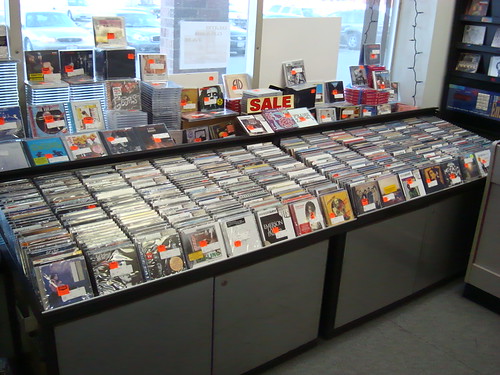
2. Catalog
Meanwhile, after years of successfully attempting to smother competition by maintaining a massive inventory of music, the big boxes were beginning to scale back on CD floorspace in favor of DVDs, which were still a red-hot commodity. The once-impressive rows of CDs Best Buy used to boast suddenly started looking rather thin as they were now prioritizing guaranteed hit music over "marginal" catalog or independent releases/reissues. Sure, you could walk down an aisle there and see a truly massive U2 section sporting about 150 CDs, but upon closer inspection you'd realize that 130 of those CDs were copies of How To Dismantle An Atomic Bomb with a couple copies each of 4 or 5 other titles sprinkled about for appearances sake.
This restructuring of priorities at the big boxes created an opening for us, and we charged straight into it. The Den started attracting people who had grown up with rock music and weren't quite ready to let go just yet. If we were going to keep them coming back, we were going to have to retain far more deep catalog than we ever had before, and we started adjusting our buying accordingly. Luckily, the major labels had started offering substantial discounts on their catalog in order to keep it moving outside of the big boxes, and Greg jumped feet-first into these buying programs, snapping up thousands of older CDs at reduced rates and passing the savings along to stimulate sales. We had always done a pretty good job with keeping some special, hard-to-find titles of local interest handy for whoever asked, but now we were actively cultivating a reputation as the place to get anything you hadn't heard in a quarter century or more.
Once we had the ability to buy direct from two of the biggest music companies in the world, it seemed like this end of the business really started to get rolling for us. I cannot stress enough how being able to buy directly from two of the biggest music distributors has greatly increased our ability to compete with big boxes since the catalog discount programs offered at the distributor level were far better than any one-stop could offer. For a year or so, our sale bins at the front of the store could have been called "The WMG Bins" as product from that distributor overwhelmed all else. When we got Universal opened up a year or so past that, the buying balance shifted again, and we now have what looks like a mini warehouse in the back room jammed solid with CDs from WEA and Universal. These programs, coupled with an explosion in cheaper old import titles, began to transmogrify our store into a kind of classic rock heaven on Earth.

3. Vinyl
Another factor in our longevity has been the completely unexpected re-emergence of vinyl (whether used or new) as a collectible format. Aside from dance and hip-hop 12" singles and the odd Pearl Jam LP, we had been pretty much out of the vinyl market from 1990 through the end of our days in the Great Lakes Mall. We hadn't had any plans to re-enter that market in our new location until a few months after re-opening, when a customer asked us one afternoon if we carried any vinyl records. Greg and I both shook our heads no, and when the customer then asked us why, neither of us could come up with a good answer.
With space to burn (and no better ideas to try out), we started buying and selling used LPs again for the first time in a decade. Initially, almost everything we set out to sell was priced at a dollar, with a few premium pieces going as high as five. Sales were steady, but slow, and as more people got wind of the fact that we'd take their old boxed-up records off their hands, our stock began to outgrow the bins we'd set aside to contain it. For some time, this became a concern, especially as we began stockpiling everyone's grandmother's record collections in boxes piled six feet high in the back room while the vinyl bins overflowed and spilled onto the floor. There were times when it was getting so crowded in the back that we were seriously considering shutting off all vinyl buying in an attempt to keep our stock under control, and that is when we started running into the E-bay people: the guys who earn a living buying crates of stuff at rock-bottom prices from anybody who would sell it to them and then finding people online who would pay them for whatever goodies they might come across.
At first, we were amused (and relieved) when the E-bay people would show up and cart off boxes of moldering records at a time, but it became apparent over time that LPs could become a valuable part of our profit margin, and we started becoming a bit more hands-on in the pricing and buying of used vinyl instead of simply buying everything in at a flat rate and blowing it out the door ASAP. While we still occasionally buy "by the pound" if a customer doesn't feel like going store-to-store looking for a better deal, we now have a pretty decent idea which records are worth paying more for (almost any band or act we've never heard of before) and, more importantly, which ones aren't (pretty much every album released on Columbia between 1973-1987).
These days, used vinyl sits in every open nook and cranny in the store, with the premium titles arranged semi-alphabetically in specially made bins in the back while everything else is boxed up or lined up wherever we can find room. Quite frankly, we need a better way to display our vinyl stock: sales have picked up in intensity to the extent that used LPs now regularly out-sell used CDs on a piece-count and dollar basis,and our used CDs are far easier to browse than our vinyl. Also, the profit we are able to realize from selling used vinyl has been instrumental in keeping us afloat and amending for the relatively thin margin afforded by contemporary CDs, thus we definitely owe it to ourselves to come up with some kind of new solution to displaying the hottest selling items in the store.
Now comes the weirdest part: over the last two years, used vinyl has started to bring back a good chunk of the younger customers we figured had been lost for good to downloading. Somehow, a lot of younger people have glommed onto vinyl being a more immersive, meaningful, and (let's not kid ourselves) hip listening experience than an mp3, and they have embraced the format to a mind-boggling extent, whether used or new. Where we once spent most of our time with visiting sales reps screaming about CD prices and crappy marketing ideas, now we're always pleading with them to get as much classic rock vinyl into the marketplace as quickly as possible, because we sell it faster than we can keep up with it.

For the first time since opening up at our current location, I think we've achieved the kind of store we'd always imagined we could run back in the old days when a slow afternoon could be spent blue-skying a Deak-free existence in the now-museum like expanse of Great Lakes Mall. We are all very proud of what Record Den has become and also hoping we can keep it going at full steam even as the U.S. economy goes to Hell in a hand basket all around us.
While the plan is to keep going as long as we can, the near future remains a bit hazy as I write this: our lease comes up next year, and preliminary negotiations between Greg and our corporate landlords have deadlocked over rent (they want to raise it over time, he wants a constant rate in exchange for a longer lease). For the time being, we're letting the landlords stew for a while as time is presently on our side: the longer we wait, the better idea we'll get of where we're going in a financial sense. Already lagging behind the pace of a flat 2007, we are now facing what could be a brutal summer, what with gas prices at 4 dollars a gallon (and the price of oil continuing to climb, dragging behind it the cost of just about everything else in existence) and the entertainment dollar being stretched tighter than perhaps at any point in the last thirty years. We're working just to keep ourselves respectably close to our target figures, but this has not been a banner year thus far.
What happens this summer (not to mention over the following Christmas) will impact any long range plans Greg comes up with between now and then. It's hard to guess what to expect, but I would be very surprised if Greg opts to stick in a fork in this operation next year, largely because we have an awful lot of inventory to sell, and barring the launch of a full-time internet operation, I can't imagine what the hell we'd do with all of this stuff should our day of reckoning come earlier than expected.
My feeling is that we'll end up renewing our lease on a year-to-year basis and keeping our options open. As long as people remain willing to buy music on a physical format in a retail environment, Greg will want to be open to provide that service. He has said many times in the past that he was playing to be the last man standing at local indie music retail, and you can certainly argue that he got his wish. I hope this doesn't sound like we're gloating, because we both miss the days of friendly competition and being able to visit places like Record Revolution, My Generation, Platterpuss, or Repeat The Beat: discovering cool imports and underground releases we'd never seen or heard before. This was part of the fun of working in this business, and most of it is now long gone. Sure, we're very happy to still have our doors open, but it's kind of a drag on a personal level when the nearest store that even remotely resembles our own is nearly 50 miles away.
While the business side is pretty much up to Greg, there is also a possible decision to be made on my end as well. While being a Den lifer thus far has brought a measure of reassuring stability to my life, I'd be lying if I didn't admit that I have stretches of dealing with John Q. Public that make me wonder how much longer I want to keep on doing this, (especially if we do wind up getting a multi-year lease offer to stick). After years of always taking the money instead of some time off, a vacation at last looks like a reality for me, and that might be enough to "reset" and refresh myself for a bit and simply get away from the grind. If it sounds waspish and antisocial to say that I need a break from being around people, then so be it. The status of Sarah's education and job will also weigh in on my decision, particularly if she feels that better opportunities are lying in wait outside of Ohio.
Certainly, there will be much dwelling, discussion and consideration as the end of this year draws close, but the one implacable constant lying at the bottom of all of this is the simple fact that I still love my job and the idea of dropping it on my own accord in lieu of an occupation that I don't love is a rather daunting prospect, to say the least.

Sunday, June 15, 2008
I, Shutterbug
A love of photography seems to run straight down my dad's side of the family. When I was a toddler, my dad was always taking home movies of drag racing, or family gatherings, or just pudgy little me ambling about the apartment on Super-8. When he was off on business trips, he often covered his international travels with his trusty stereo camera, which produced overlapping shots that had to be framed on white cardboard and then viewed through a kind of battery-powered binocular View Master device to achieve the desired 3-D effect (using that thing was kind of like taking the visual test when you renew your driver's license).
Over the last few years, Dad has been out and about with his new super-modded digital camera (with rocking lens attachments), taking increasingly sophisticated pictures to the extent that for a while you were likely get more hits off of his archived amateur photography than my archived professional writing if you ran a Google search on our common name.
Meanwhile, for as long as I've known him, my uncle Kevin has made his living doing personal or corporate photo shoots, either freelancing back when I was a kid or from his own studio which he's worked out of for the last twenty-five years. In 1985, I spent a summer working alongside him, both at his professional studio and in the cramped, dank darkroom he created in my grandmother's basement. At the time, I found some aspects of photography of interest, but overall I never caught the bug. One reason is I hadn't taken into account the sheer amount of grunt work that went into setting up a professional shoot, which seemed to leech a lot of the glamour out of the job. The technology of the era probably didn't endear me to the job, either: working with darkroom chemicals is stinky and time-consuming and easy for someone as graceless as me to completely screw up. There was also my near-crippling obessesion with music that was a constant distraction for me: I spent far more time diving into the mystique of New Order than, say, studying for school or daydreaming of a career behind the lens. Put it this way: the high points of my brief apprenticeship with my uncle was a trip to a local radio station and the acquisition of my own Sony Walkman with the earnings I had accrued. I think you can see where my priorities were.
I'd messed around off and on with Sarah's old digital camera when she owned one, but it was the acquisition of a far more advanced model of my own back in March that has awakened the genetic-level shutterbug that must have been dormant in me since birth. I've been constantly reaching for the camera (or wishing I had it handy) over the last couple of months, and the volume of images on my hard drive has reached the point where I recently opened a Flickr account to host some of the better shots I've been getting since starting up my new hobby. In the future, I'll be linking from this blog to new photography sets of days out and about, baseball games, local scenery, or even subject themes as they are assembled. Hope you like 'em.
Sunday, June 08, 2008
(Twenty Years) Part 15: Raid
 The once-booming market in live bootleg CDs had been in flux for some time in early 2001. In the years following the enforcement of GATT, finding workable sources for these illicit titles was like playing a game of Whack-A-Mole (for us as well as the authorities). Also, as good titles became harder to locate, the packaging standards had started to head down the tubes, both in terms of the once-ornate booklets and cover art as well as the source music, which was occasionally being sourced not from original show tapes but from compressed digital files grabbed right off of the internet.
Granted, these were bootleggers we were dealing with and not, say, Mobile Fidelity Sound Lab, so there wasn't an awful lot you could say when you got a dozen copies of a Metallica concert burned onto a generic CD-R with paper artwork straight out of a cheap PC printer and the songs all separated by a second or two of silence (since the manufacturers not only used mp3 files, but couldn't even be bothered to burn the stupid shows using Disc-At-Once). It's not like these things were sold on any kind of returnable or guaranteed basis, either: once you bought 'em, they were yours forever. For the first time since we'd started buying them in the late 80s, the problems of carrying bootlegs were starting to outweigh the benefits.
Around the end of 2000, we had found a new and local source for boots, and we'd get our orders from this guy quite literally in pieces: that is, CDs in one box, artwork and jewel cases in another. It wasn't a ton of fun standing there behind the counter and putting these things together for hours on end, but I guess it beat shrink-wrapping stacks of Italian vinyl albums in the silent back room of J.J. Newberry's. It was, of course, right while I was elbow-deep in illicit CD components that a handful of Mentor's finest came barging into the store, demanding to talk to the owner right now, while two belligerent RIAA agents threatened us with immediate shutdown if we didn't comply with their demands. Wheeee.
Over the next three hours, we had to stand by and watched as hundreds of CDs were seized and removed from the premises by the RIAA goons, with the men in blue providing the muscle. The detective in charge of the operation handled the bust as fairly as we could have hoped for, considering we had been caught completely red-handed. The RIAA guys, on the other hand, were a couple of arrogant little woodpeckers who demonstrated an amazing ignorance of what was a bootleg CD and what was not: there were a flashes of contentiousness as we would testily point out to them that such-and-such particular import live release was not, in fact, a bootleg.
In the days and weeks afterward, some friends of ours speculated that Deak must have had something to do with this bust as the timing was just too perfect to ignore. Sure, conspiracy theorists have spun vast, intricate webs of causality out of far less remarkable coincidences, but I'm fairly certain that one had nothing to do with the other in this instance. But talk about a shitty opening week ... in one day, seven grand in inventory that had just been purchased from the previous owner was wiped from the books and is probably still sitting in an evidence storage room somewhere. Ouch. We were also forced to play nice with the RIAA and help them shut down our local boot distributor as a trade-off for avoiding prosecution. When all was said and done a few weeks later, we were given an admonition from the Mentor PD never to traffic in these recordings again and that was that.
While losing a ton of money was not what I had in mind, I'd been secretly wondering for years when we'd finally leave bootlegs behind, end our constant worrying about excess visibility and stop having to play dumb whenever we were asked directly what these discs were and where they were coming from. Financially, this was a nasty blow for an operation just getting started: we're fairly certain that the total loss of that area of business cost us the year as 2001 was the first of only 2 down years we've experienced since we opened in our current location (the other, being last year, was more flat than down). That said, it was a secret relief for me to close out that particular chapter of our existence.

Tuesday, May 13, 2008
(Twenty Years) Part 14: Emancipation
 It was a year and change after I became the assistant manager of the store that the day we had been waiting for all these years finally arrived: Deak had decided at last to walk away from Record Den and was negotiating the sale of the store to Greg. Typically, we found out later through other sources that selling to Greg hadn't been Deak's first choice (shocker!), but apparently no one else had been interested in buying out the location, leaving him with no choice but to work with Greg's terms. I don't even want to think about what would have happened if he had sold a store out from underneath us again, but it certainly wouldn't have been pretty.
As you might have guessed by now, Greg's nearly three decades of loyal service to the Record Den chain were richly rewarded at the end as Deak relentlessly attempted to squeeze as much dosh as possible from anything not nailed down. The negotiations, such as they were, followed a similar pattern throughout: Deak ratcheted the price of every display fixture and desk organizer on the premises as high as he dared, and then Greg would endeavor to argue him down to a suitable meeting point. There were even a few times during this process when Greg would outright refuse an offer, either trying to play hardball or from outright disinterest (this was the case when Deak was asking silly money for the internet rights to the "Record Den" name, which we wound up declining).
Interestingly, we noticed during the negotiations that Deak still seemed to place a high value on the "Record Den" name on the wholesale front, yet he had to know as well as we did that our name was Mud as far as the industry at large was concerned. In reality, the only true value the words "Record Den" had to anyone was with our customers, none of whom had any idea of the credit shenanigans our company had pulled with the majors over the previous decade. That said, it's pretty surprising that Greg was able to get us an open account with WMG (Warner Music Group), and nothing short of miraculous that he eventually finagled a way to buy direct from Universal (the biggest of the Big Four, and the Godzilla of music distribution).
While I'm sure that Greg's longstanding reputation with many sales reps and promotional execs is a lot of what greased the wheels with WMG and Universal (particularly the former), it's also fair to assume that our new company name helped put their respective credit departments at ease. The creation of "Walrus Music" as a corporation was a deliberate move to separate this new venture from the old "Record Den" in the eyes of our would-be creditors. The name was the end result of Greg and I volleying Beatle-themed ideas back and forth for a day or so in search of a cool sounding company name. I would like to note here, for the record, that I think "Walrus Music" was a bit too obvious a choice: I was trying to come up with far more obscure points of Fab reference in my ideas. That said, I have to admit that Greg probably had a point when he noted that my favorite idea might not be the most inviting-sounding business name ever ("Hello, this is Slagger's! Can I help you?"), and since he was putting up the dough to start the corporation, "Walrus Music" won the battle.
With no announcement (save for the few friends and store regulars who had been aware of the situation) or fanfare whatsoever, Record Den officially became Greg's business at the end of March, 2001 with the newly-incorporated Walrus Music taking over all operations. While we looked exactly the same on the outside, it felt wonderful walking into the store that day, knowing that we would never have to deal with Deak on a professional basis again and relishing our new found independence. Finally the masters of our own destiny, we started working out new ideas on changing things around to our liking, and wouldn't you know, the first major change to the store occurred within days of Greg's taking control ... about two, to be precise.
Monday, April 07, 2008
(Twenty Years) Part 13: I Can't Quit You Baby
 While I was never a stereotypical 90s "slacker" type in appearance, there is no question that my work ethic occasionally warranted an outside adjustment. At odd times, this was simply a matter of growing comfortable and complacent with the job, and there were a couple of other occasions where I was going through some kind of life turmoil that greatly interfered with my ability and/or willingness to do anything aside from show up and occupy space behind the counter. There were never shouting matches over this (this wasn't Greg's style), but the point would be made and, if necessary, enforced by my hours being reduced to part-time (spring 1994), or being placed on involuntary sabbatical in order to get my head together and figure out what the hell I was going to do with myself (spring/summer 1990).
By the middle of 1999, though, there were new forces in play that began to affect my work performance. For the first time since I was hired, I was finally starting to tire of forever being "third key." This change in attitude was precipitated by two factors: 1) I was pinned under the proverbial glass ceiling being the third man on a three-man crew, and 2) I had met Sarah during that spring and was presented with a choice to relocate, start anew, and perhaps move up from my present position whilst doing so.
When Beth (the store's longtime assistant manager since 1989) left Record Den at the dawn of 1997 for a job downtown with the Cleveland Indians organization, I was passed over for promotion by a co-worker who had been hired 6 years after me. Thankfully, there has never been any rancor between me and Brian (who had moved ahead of me) over this, for I knew full well that I had deserved the snub considering my recent performance, and the simple truth of the matter was that Brian was the better pick of the two of us due to his retail management experience from previous jobs.
Another factor that kept any possible hurt feelings at bay is that I had been offered management jobs in the company before (I had turned down, after much internal debate, an offer to run the Great Northern Mall store during the fall of 1995), and I figured it was only a matter of time before another opportunity presented itself. What I didn't count on, of course, was the complete disintegration of the entire chain over the next two years, which effectively left me stuck at #3 for the foreseeable future. D'ohh.
 Towards the end of 1998, a new opportunity did come along, but not from Record Den: Scene magazine, a local entertainment newsweekly that I had been freelancing for over the previous two and half years, was being bought out by the Phoenix-based New Times media group (now called the Village Voice Media, as I discovered while researching this post). The situation at Scene was almost perfectly analogous to what had happened the year before at the store when Record Town had come calling: anyone who wanted to stay at Scene was offered employment under the new ownership, but it was going to be a very different kind of publication than what had existed before and, unsurprisingly, most of the editorial staff abandoned ship as the transition drew near.
From the tone of his voice, it sure didn't sound like incoming music editor at Scene was very pleased with the situation he was rapidly finding himself in as everyone walked off the plank instead of swearing eternal fealty to New Times. In a subsequent fit of pique, or perhaps in a "Year Zero"-styled move to wipe out the past and start from a new blank slate, New Times consigned the old Scene culture to oblivion as every single pre-transition article and review (thousands of record, movie and concert reviews, interviews and news stories covering the Cleveland music scene going back nearly 3 decades) vanished from the web archives forever. Jerks. I sure hope someone somewhere is keeping every issue of the old Scene magazine in safe, dry place, otherwise this represents an incalculable loss.
Anyway, back to that opportunity: as we watched a high school football game and chatted about the New Times situation one Friday night that October, Steve (my editor at Scene) told me of a brand new entertainment weekly called Spot that he was seeking to get off the ground. If memory serves, Steve had managed to snare three or four of the senior music writers (of which I was one) from Scene, along with a couple of other contacts/friends from the outside to make up his new staff.
The idea was that Spot would quickly move to flank Scene, which we knew was almost certainly going to veer away from the all-music format it had owned since its inception and skew towards the socio-political turf long patrolled by the Cleveland Free Times. Spot would also attempt to reclaim Scene's old territory with a more irreverent, eye-catching approach to news coverage than the well-worn, familiar Scene style (for reference points, Steve had in mind such vibrant British music monthlies as Q and Mojo). The most enticing prospect was that if everything worked out, we would would have the entire "local entertainment" playing field all to ourselves. After laying all of this out, Steve then asked me if I could commit full-time to the new venture.
At the risk of cheapening the moment with an unintentional pun, this was one of the toughest decisions I ever had to make on the spot. I had started freelancing for Scene on a pure lark in the spring of 1996 after years of wanting to make some kind of inroads into professional writing. The whole gig had come about from me asking a regular Scene contributor named Lee (who had been coming into the store for years) exactly how one applied for a writing position down there. Lee basically told me to knock off a few "demo" album reviews and send them down to Steve's office for approval. To my great surprise, I was brought on board immediately and started submitting copy within days, eventually "graduating" to concert reviews, interviews, and feature articles. While the pay was minimal and on a per-article basis, I was finally taking steps towards my old dream career, and what I was being offered by Steve that fall evening was basically the full-time writing job I'd been wanting for years.
However, there were two problems that made me chew this over for a minute or so before I could respond. Firstly, I knew that the survival rate of new startup magazines beyond six months wasn't very good, and regardless of their new approach, we'd be going up against two long-entrenched local 800 pound gorillas. Granted, Spot wouldn't be fighting the twin titans head on as our content would be quite different from theirs, but we would have to call in favors and take a lot of time setting up credentials, advertising accounts, and taking a long, slow route to possible success.
Then there was a question of loyalties, plain and simple. While I felt like I owed Steve for giving me a shot and then respecting me enough to offer a full-time position at his next venture, I had known Greg a decade longer and felt equally, if not more indebted to him for keeping me employed over the previous eleven years. As much as I loathed having Deak skulking around the back room all day, the thought of leaving Record Den when we were just getting started over again tore at my insides. After a few months of steadily increasing momentum, sales were starting to take off and we were all excited by what might be possible as our first Christmas season in our new location approached. To make a move to Spot, I would have to jump ship from the Den at the worst possible time to do so, and that alone was unthinkable. Even if the timing hadn't been as terrible as it was, I knew full well that there was no room for a fourth full-timer at the store, and if Spot were to fail, I would be pretty well screwed for a job, at least in the short-term.
After a minute or so of thinking everything over, I declined Steve's offer. I would be more than happy to keep on writing and coming up with content ideas, I told him, but I couldn't leave the store at this time after all we'd gone through to land it and then set it up. I think Steve understood, though I still felt terrible for turning him down. After I dropped him off at his apartment later that night and drove home down Route 2, I wondered if I might have just made the biggest mistake of my life, because it sure felt like it.
As it turned out, I couldn't have been more wrong: about four months later, after a half-dozen or so issues had been distributed around the Cleveland area to a promising initial response, it appears that, depending on how you interpret this brief wrap-up piece, either Steve had a catastrophic falling out with the publisher or (as I had heard) Spot's sole financier developed a lethal case of cold feet and pulled the plug on the whole enterprise. It didn't matter, really: Spot never published again. The dream was over.
Steve was a pretty low-key guy emotionally, but you couldn't miss the anger and betrayal in his voice as I talked to him a day or so after the shit hit the fan. I wasn't sure what to feel: on one hand, the end of Spot ultimately marked the end of my professional writing career. On the other, I had somehow made the wisest decision of my life to that point and thus had a full-time job to fall back on, while Steve (after a stint that following Christmas working for us as part-time help) eventually landed at Lincoln Electric for a while, then ran a CD Warehouse outlet in Mayfield, and now, it appears, lives in New York City.
Within weeks of Spot ceasing to exist, Sarah and I had become an online item, and as that situation developed further, the feeling that I wasn't going anywhere at Record Den had started to gnaw at me to the point where I was seriously considering moving to Columbia, Missouri (where she lived) to see what life had to offer a thousand miles from home. With hardly anything to keep me here if I left the store, the plan was that I'd work through Christmas, save up what I could, and move sometime in early 2000. This idea was sweetened considerably when Sarah informed me that the big record store in Columbia was now hiring for a full-time position. Yahtzee! I sent off a letter and resume to the store owner, shortly thereafter informing Greg of my plans.
January 2000 came around at last, and Western civilization had failed to collapse in on itself despite all the media hysteria that the Y2K bug would send us all back to the stone age at the stroke of midnight on New Years Day. I was just starting to make final preparations for the move when the news came down that the job I thought I had a fairly good shot at was not going to happen (and I'm very glad this news was passed on to me before the move, because Goat knows what the hell kind of chaos that little snafu might have wrought after I had already arrived in Columbia). With that opportunity gone, my spirit was broken and all the little doubts about this idea that had been flittering about in the back of my mind (that I had been studiously ignoring for weeks) suddenly became a very big deal. Perhaps a bit panicked by the sudden change in the situation, I began to reconsider the idea of moving, and wondered if I might be better off staying in Ohio instead.
As luck would have it, I didn't have to think about this very long: a week or so later, Brian had accepted an offer to work full time for our ex-assistant manager Beth at a warehouse she had opened in Willoughby. While he wouldn't be leaving Record Den permanently (he offered to work Sundays in order to keep up with the biz and give Greg and I a common day off), Brian would no longer be available to be a full-time assistant manager, and the job was suddenly mine if I wanted it.
Not being a complete moron, I accepted the promotion.
(Picture of me flipping the bird while reading Q magazine by Dave M.)
Monday, March 10, 2008
(Twenty Years) Part 12: The Dead Walk!
November 30, 2007 marked 20 years to the day since I started at Record Den, which has inspired some thought and reminiscing on the person I was then, what the job was like as the years went by, and what has kept me around until now ...
 We'd been privy to random strokes of luck (both good and bad) over the years, but this one just might have topped them all: Record Town had royally fucked up. Big time.
At odd times over the month of December, Greg and Deak would discuss the new store we had been promised in exchange for working that Christmas season at Great Northern Mall. The news from Deak was, at first, discouraging: it was a foregone conclusion that a non-compete clause in the sales contract that had been drawn up for the Great Lakes Mall store would keep us out of the city of Mentor for good (or long enough that it might as well be). In most cases, the terms of these agreement keep you from operating anywhere within five-miles of the place you sold your property to, which would mean that if we wanted to call ourselves "Record Den," we'd have to open somewhere in Willoughby, possibly Painesville, or maybe even Mayfield Heights.
Before we started scouting out locations, we'd need to know exactly what our legal options were, and Greg asked Deak to verify what we could and couldn't get away with. A few days later, the word came back from Deak's lawyer: not only was no such "safe distance" spelled out anywhere in the agreement, but there wasn't a "non-compete" clause in the contract at all.
We looked at each other, stunned, as this news was relayed to us: this was better than we ever could have hoped for. Deak set about looking for a vacant location in Mentor and eventually settled on a half-empty strip mall that was located within sight of Great Lakes Mall which, for our old customers, would make us a cinch to locate. On the negative side, however, we would also be about 500 feet from the front door of the local Best Buy location: certainly not the most desirable new place to set up shop, but it was the best option available.
With the opening of the new Mentor location set for early February, we had to play out the string at Great Northern just a little bit longer. For me, this was easier said than done: the standard post-Christmas slowdown that had always driven me to distraction in Mentor was far worse in North Olmstead, probably because I was now driving about 40 miles to feel bored instead of 5 and change. I tried to let the promise of a new store forty minutes closer to home give me the energy to withstand the grind out there for a couple more weeks, but by the middle of January, with the Fiero continuing to run erratically and real winter weather finally starting to arrive in the area, I couldn't take it out there anymore and requested a week off, timing my first day back at work to be the day we started fixing up our new location.
 Our new digs had previously been the domain of a waterbed emporium and had been vacant for some time. Most of the preliminary work our District Manager had done was centered around removing some old drywall slabs that had once sectioned off the floorspace for display purposes and replacing them with two new (and slightly leaning) walls that sectioned the store off into a sales floor and a back room. The dimensions of the new back room were quite large, giving us room for a rear manager's office and nearly thirty feet of open space opposite that space for ... a whole lot of storage and a lunch table, I guess. It seemed like a lot of space was being wasted back there, but the sales floor itself was more than big enough to suit our purposes for the time being, so we didn't really mind.
 One of the first things we did was relocate a freakin' huge two-level counter squatting uselessly in the back room area to the front of the store. That behemoth was absolute murder to move (and will likely never move again without busting), but we figured (correctly) that Greg would positively flip over the all the open space he would have to place piles of CDs, blank tapes, lighters, patches, incense, key chains, and whatever else he could think of in people's faces. To this day, the front counter remains the center of the action, if you will: all regulars who drop by make it a point to stop there first and scope out what is new, noteworthy, or on special.
 It ultimately took us the better part of a decade to fully utilize all of the room we had available in this new store: early on, we were far more spacious than we are as I write this. While the basic layout of the new Record Den is still pretty much the same as it was in early February 1998, this location was stitched together slowly, as pieces and parts from the old "Traveling Road Show" arrived whenever another location closed down, and it was this haphazard fashion of acquiring displays (and product) that allowed us to shape and re-shape the store over time.
 By the time we opened the new location on Saturday, February 14, 1998, a conga line of mis-matched CD bins stretched down the entire middle length of the store. The east wall was dominated by cassette display cases, while plastic and metal shelving occupied the slat boards arranged from head-to-toe level everywhere else. As a final touch, we hung up dozens of rock-themed black tapestries from the acoustical tiles in the ceiling (a little display trick we'd picked up from Great Northern) to try and eat up some of what felt like an ocean of open space.
With a little spit and polish, we had made ourselves look presentable for the public, but a few new issues were already presenting themselves by Opening Day, with a few more coming up over our first few months of operation that not only dulled our early euphoria, but also made us begin to regret our decision to stay within the Record Den corporation.
The first issue we had was the new sign for the store: done on the cheap (surprise!), it was a two-piece red-on-yellow design printed on lightweight corrugated plastic that tended to bow and vibrate in the wind. While it was big, bright and clearly visible from hundreds of feet away, it was also a major pain in the ass to deal with. None of us liked the sign from the day we set it up (we had to use transparent packing tape to hold the damn thing together, for crissakes), and it often came loose from its mooring, even blowing halfway down on a few gusty (and embarrassing) occasions.
Far more worrisome to us was the product situation, which was in flux once again. While boxes of CDs and tapes had been shipped our way the instant we started setting up shop, there were nowhere near enough of them for our liking. Despite loading up the TELXON with stock orders, very little was appearing from the warehouse, and a lot of what was appearing was obviously being shunted our way from other stores in the chain. To our mounting irritation, it had become apparent that we'd be opening with only a skeleton inventory: our initial plan had been to overwhelm people from the instant we opened, in effect saying "we're back and nothing is changed!" but that was just not to be.
Basically, two things had happened:
1. The money from the sale of the Mentor store was already nearly used up, and Deak was in the process of selling off the rest of the chain piecemeal. One of the stores he sold that spring was the Great Northern Store we had just refurbished over the previous Christmas break. It's only business, of course, but I felt oddly cheated to have spent five weeks of my time getting that store back on its feet only to have it sold to NRM the minute we were finished.
2. Deak was in the process of completely screwing over every single major supplier he did business with. Playing shell games with his money (largely as a result of his divorce settlement), he cried poverty with the major labels, declaring himself bankrupt and forced the labels to either accept reduced payments (say, ten cents on the dollar) or nothing at all. The labels, having no choice, took the reduced amounts and zeroed out their Record Den accounts for good. It was stunts like this that left the chain saddled with an absolutely horrendous reputation at the wholesale level: a reputation that would be tripping us up for years to come as we'd search for new or alternate suppliers as the need arose.
Then came the worst news of all: with the Record Den chain being chopped up and sold off to the highest bidder, Deak obviously had no further need for a warehouse. With only one or two remaining stores left to worry about, he also had no need for his support staff. Paring down the workforce to two (both of them largely secretarial positions), Deak shuttered the warehouse/headquarters complex in Mayfield and relocated his office ... to the "mysteriously" over-sized back room of our new store.
To say we were horror struck by this development would be underselling it: things had been tense enough around the store when we dealt with Deak face-to-face only once or twice a week during the transition and opening, but now we'd be dealing with his presence every day for the foreseeable future. Once we realized the real reason the back room was so large, it became obvious that this move had been in the cards from the day this new store had been picked out. Moreso than ever before, I thought we should have bolted when we had the goddamned chance. I felt like we'd been had.
Greg wasn't at all pleased with this development either, but he had also been developing a fair degree of bargaining leverage with Deak ever since the selling of the Great Lakes Mall store and the refurbishing of the Great Northern Mall location. Thus, an understanding of sorts had apparently been reached between the two of them: no matter what, he knew what he was doing and Deak was to step back and keep out of the way and let us run the store as we saw fit. Incredibly, this understanding seemed to sink in, and Deak largely stayed out of our hair over the next three years. It wasn't always easy having him back there, and there were a few occasions when Greg would deliberately play the loudest, most obnoxious CD he could get his hands on (Deak's office was positioned directly below one of the massive speakers at the rear of the sales floor) as a measure of revenge for being second-guessed or micromanaged.
It took a while for our new location to become viable: business had started off very wobbly (our gross total for the month of February, 1998 amounted to less than a current week's total business), but by the fall we'd started to hit a respectable stride upon which we could base our expectations from month to month. We also changed greatly in character as a store: following many years of being a "Top 40" kind of outlet in composition and sales, competition with the Evil Empire across the street had started us down in a far more overtly college rock/underground direction. Within a year or so, we had started figuring out how to flank Best Buy and eke out an existence batting clean-up on some mainstream titles while delving farther into independent, deep catalog, and import product.
As time passed, and the effects of the music industry's short-sightedness became more apparent, we began to realize just how lucky we had been in the long run that Deak had sold the Great Lakes store out from under us. It's funny to write this now, but Deak's desperate, ill-fated attempt to save his own floundering company ultimately resulted in what we have now (though certainly not by conscious design). We now depend heavily on used vinyl, CDs, DVDs and even some VHSs to generate the profit margins that are now a near-impossibility with contemporary hits, and this reliance would have been impossible in the mall (who frowned on the idea of anything used being sold anywhere on the premises). We have no dress codes, no silly restrictions on window displays, no enforced sidewalk sales, we can set our own opening and closing times and we play whatever music we like. Perhaps even more than our original run-down, cluttered J.J. Newberry's location, this is truly our own store.
Oh, one more angle to follow up before we move on: not long after we opened, a gaggle of Record Town execs stopped by for a visit and oh, were they pissed. No longer was it all smiles and "glad to have you aboard," but instead a lot of veiled threats, banging of shoes on tables and cries of "vee vill crush you!!" I sometimes wonder if one of these guys (or, more likely, some poor schmuck in their legal department) eventually lost their head for neglecting to dot their i's and cross their t's when they drew up that sales agreement for the Great Lakes Mall store. It didn't matter much in the long run: within a year, they had quit fencing with Camelot Music and opted to simply swallow them up instead. In time, this newest subsidiary of the Record Town empire changed their name to FYE (For Your Entertainment), and their massive, sprawling "lifestyle"-themed superstore was cut down to less than half its old size and refitted into a typical mall record store. C'est la vie.
 (Pictures of the store taken by Dave M.)
 We'd been privy to random strokes of luck (both good and bad) over the years, but this one just might have topped them all: Record Town had royally fucked up. Big time.
At odd times over the month of December, Greg and Deak would discuss the new store we had been promised in exchange for working that Christmas season at Great Northern Mall. The news from Deak was, at first, discouraging: it was a foregone conclusion that a non-compete clause in the sales contract that had been drawn up for the Great Lakes Mall store would keep us out of the city of Mentor for good (or long enough that it might as well be). In most cases, the terms of these agreement keep you from operating anywhere within five-miles of the place you sold your property to, which would mean that if we wanted to call ourselves "Record Den," we'd have to open somewhere in Willoughby, possibly Painesville, or maybe even Mayfield Heights.
Before we started scouting out locations, we'd need to know exactly what our legal options were, and Greg asked Deak to verify what we could and couldn't get away with. A few days later, the word came back from Deak's lawyer: not only was no such "safe distance" spelled out anywhere in the agreement, but there wasn't a "non-compete" clause in the contract at all.
We looked at each other, stunned, as this news was relayed to us: this was better than we ever could have hoped for. Deak set about looking for a vacant location in Mentor and eventually settled on a half-empty strip mall that was located within sight of Great Lakes Mall which, for our old customers, would make us a cinch to locate. On the negative side, however, we would also be about 500 feet from the front door of the local Best Buy location: certainly not the most desirable new place to set up shop, but it was the best option available.
With the opening of the new Mentor location set for early February, we had to play out the string at Great Northern just a little bit longer. For me, this was easier said than done: the standard post-Christmas slowdown that had always driven me to distraction in Mentor was far worse in North Olmstead, probably because I was now driving about 40 miles to feel bored instead of 5 and change. I tried to let the promise of a new store forty minutes closer to home give me the energy to withstand the grind out there for a couple more weeks, but by the middle of January, with the Fiero continuing to run erratically and real winter weather finally starting to arrive in the area, I couldn't take it out there anymore and requested a week off, timing my first day back at work to be the day we started fixing up our new location.
 Our new digs had previously been the domain of a waterbed emporium and had been vacant for some time. Most of the preliminary work our District Manager had done was centered around removing some old drywall slabs that had once sectioned off the floorspace for display purposes and replacing them with two new (and slightly leaning) walls that sectioned the store off into a sales floor and a back room. The dimensions of the new back room were quite large, giving us room for a rear manager's office and nearly thirty feet of open space opposite that space for ... a whole lot of storage and a lunch table, I guess. It seemed like a lot of space was being wasted back there, but the sales floor itself was more than big enough to suit our purposes for the time being, so we didn't really mind.
 One of the first things we did was relocate a freakin' huge two-level counter squatting uselessly in the back room area to the front of the store. That behemoth was absolute murder to move (and will likely never move again without busting), but we figured (correctly) that Greg would positively flip over the all the open space he would have to place piles of CDs, blank tapes, lighters, patches, incense, key chains, and whatever else he could think of in people's faces. To this day, the front counter remains the center of the action, if you will: all regulars who drop by make it a point to stop there first and scope out what is new, noteworthy, or on special.
 It ultimately took us the better part of a decade to fully utilize all of the room we had available in this new store: early on, we were far more spacious than we are as I write this. While the basic layout of the new Record Den is still pretty much the same as it was in early February 1998, this location was stitched together slowly, as pieces and parts from the old "Traveling Road Show" arrived whenever another location closed down, and it was this haphazard fashion of acquiring displays (and product) that allowed us to shape and re-shape the store over time.
 By the time we opened the new location on Saturday, February 14, 1998, a conga line of mis-matched CD bins stretched down the entire middle length of the store. The east wall was dominated by cassette display cases, while plastic and metal shelving occupied the slat boards arranged from head-to-toe level everywhere else. As a final touch, we hung up dozens of rock-themed black tapestries from the acoustical tiles in the ceiling (a little display trick we'd picked up from Great Northern) to try and eat up some of what felt like an ocean of open space.
With a little spit and polish, we had made ourselves look presentable for the public, but a few new issues were already presenting themselves by Opening Day, with a few more coming up over our first few months of operation that not only dulled our early euphoria, but also made us begin to regret our decision to stay within the Record Den corporation.
The first issue we had was the new sign for the store: done on the cheap (surprise!), it was a two-piece red-on-yellow design printed on lightweight corrugated plastic that tended to bow and vibrate in the wind. While it was big, bright and clearly visible from hundreds of feet away, it was also a major pain in the ass to deal with. None of us liked the sign from the day we set it up (we had to use transparent packing tape to hold the damn thing together, for crissakes), and it often came loose from its mooring, even blowing halfway down on a few gusty (and embarrassing) occasions.
Far more worrisome to us was the product situation, which was in flux once again. While boxes of CDs and tapes had been shipped our way the instant we started setting up shop, there were nowhere near enough of them for our liking. Despite loading up the TELXON with stock orders, very little was appearing from the warehouse, and a lot of what was appearing was obviously being shunted our way from other stores in the chain. To our mounting irritation, it had become apparent that we'd be opening with only a skeleton inventory: our initial plan had been to overwhelm people from the instant we opened, in effect saying "we're back and nothing is changed!" but that was just not to be.
Basically, two things had happened:
1. The money from the sale of the Mentor store was already nearly used up, and Deak was in the process of selling off the rest of the chain piecemeal. One of the stores he sold that spring was the Great Northern Store we had just refurbished over the previous Christmas break. It's only business, of course, but I felt oddly cheated to have spent five weeks of my time getting that store back on its feet only to have it sold to NRM the minute we were finished.
2. Deak was in the process of completely screwing over every single major supplier he did business with. Playing shell games with his money (largely as a result of his divorce settlement), he cried poverty with the major labels, declaring himself bankrupt and forced the labels to either accept reduced payments (say, ten cents on the dollar) or nothing at all. The labels, having no choice, took the reduced amounts and zeroed out their Record Den accounts for good. It was stunts like this that left the chain saddled with an absolutely horrendous reputation at the wholesale level: a reputation that would be tripping us up for years to come as we'd search for new or alternate suppliers as the need arose.
Then came the worst news of all: with the Record Den chain being chopped up and sold off to the highest bidder, Deak obviously had no further need for a warehouse. With only one or two
 remaining stores left to worry about, he also had no need for his support staff. Paring down the workforce to two (both of them largely secretarial positions), Deak shuttered the warehouse/headquarters complex in Mayfield and relocated his office ... to the "mysteriously" over-sized back room of our new store.
To say we were horror struck by this development would be underselling it: things had been tense enough around the store when we dealt with Deak face-to-face only once or twice a week during the transition and opening, but now we'd be dealing with his presence every day for the foreseeable future. Once we realized the real reason the back room was so large, it became obvious that this move had been in the cards from the day this new store had been picked out. Moreso than ever before, I thought we should have bolted when we had the goddamned chance. I felt like we'd been had.
Greg wasn't at all pleased with this development either, but he had also been developing a fair degree of bargaining leverage with Deak ever since the selling of the Great Lakes Mall store and the refurbishing of the Great Northern Mall location. Thus, an understanding of sorts had apparently been reached between the two of them: no matter what, he knew what he was doing and Deak was to step back and keep out of the way and let us run the store as we saw fit. Incredibly, this understanding seemed to sink in, and Deak largely stayed out of our hair over the next three years. It wasn't always easy having him back there, and there were a few occasions when Greg would deliberately play the loudest, most obnoxious CD he could get his hands on (Deak's office was positioned directly below one of the massive speakers at the rear of the sales floor) as a measure of revenge for being second-guessed or micromanaged.
It took a while for our new location to become viable: business had started off very wobbly (our gross total for the month of February, 1998 amounted to less than a current week's total business), but by the fall we'd started to hit a respectable stride upon which we could base our expectations from month to month. We also changed greatly in character as a store: following many years of being a "Top 40" kind of outlet in composition and sales, competition with the Evil Empire across the street had started us down in a far more overtly college rock/underground direction. Within a year or so, we had started figuring out how to flank Best Buy and eke out an existence batting clean-up on some mainstream titles while delving farther into independent, deep catalog, and import product.
As time passed, and the effects of the music industry's short-sightedness became more apparent, we began to realize just how lucky we had been in the long run that Deak had sold the Great Lakes store out from under us. It's funny to write this now, but Deak's desperate, ill-fated attempt to save his own floundering company ultimately resulted in what we have now (though certainly not by conscious design). We now depend heavily on used vinyl, CDs, DVDs and even some VHSs to generate the profit margins that are now a near-impossibility with contemporary hits, and this reliance would have been impossible in the mall (who frowned on the idea of anything used being sold anywhere on the premises). We have no dress codes, no silly restrictions on window displays, no enforced sidewalk sales, we can set our own opening and closing times and we play whatever music we like. Perhaps even more than our original run-down, cluttered J.J. Newberry's location, this is truly our own store.
Oh, one more angle to follow up before we move on: not long after we opened, a gaggle of Record Town execs stopped by for a visit and oh, were they pissed. No longer was it all smiles and "glad to have you aboard," but instead a lot of veiled threats, banging of shoes on tables and cries of "vee vill crush you!!" I sometimes wonder if one of these guys (or, more likely, some poor schmuck in their legal department) eventually lost their head for neglecting to dot their i's and cross their t's when they drew up that sales agreement for the Great Lakes Mall store. It didn't matter much in the long run: within a year, they had quit fencing with Camelot Music and opted to simply swallow them up instead. In time, this newest subsidiary of the Record Town empire changed their name to FYE (For Your Entertainment), and their massive, sprawling "lifestyle"-themed superstore was cut down to less than half its old size and refitted into a typical mall record store. C'est la vie.
 (Pictures of the store taken by Dave M.)
Subscribe to:
Posts (Atom)
