Showing posts with label Nostalgia. Show all posts

Monday, December 28, 2009

Boom! There She Was

One of the nicer surprises I received this Christmas was a copy of A Quiet Revolution: 30 Years Of Windham Hill. I'd been on a bit of a rediscovery kick with the old Windham Hill catalog lately, and this box has certainly helped fire up some old memories of listening to WNWV ("The Wave") off and on from 1987-1990. Outside of George Winston's ubiquitous December, I'd never owned much in the way of new age music, then again I was also twenty years younger than I am now and far more likely to seek temporary escape from life by cranking OU812, ...And Justice For All, or Delicate Sound Of Thunder rather than, say, In A Silent Way, Rubycon, or Thursday Afternoon. A lot of new age is pretty lame crystals-and-incense wallpaper, but the better examples of the form provide a nice, reflective break from the relentless fast-forward clatter of life (perhaps even moreso now than in the comparatively carefree 1980s).

Ironically, just as I received this box set in the mail (thanks again, nightscapemedia!), the news came down that The Wave would soon be no more. At noon today, WNWV flipped formats (though apparently not call letters) to the so-called "Adult Album Alternative" category and is now known as "Boom!" I'm not really enamoured with this new nick, but at least it's not some guy's name.

Charting the first six hours of their existence (you can listen online here), Boom! so far sounds exactly like a "greatest hits of AAA radio" with a generous helping of songs seemingly grabbed from my "Juke" mp3 folder. A playlist of these first few hours follows:

THIEVERY CORPORATION - Radio Retaliation
BRUCE SPRINGSTEEN - Radio Nowhere
COLDPLAY - Clocks
SARAH McLACHLAN - Possession
TRAIN - Hey Soul Sister
U2 - Magnificent
MELISSA ETHERIDGE - Bring Me Some Water
OWL CITY - Fireflies
ROBERT PLANT & ALISON KRAUSS - Gone Gone Gone
STEELY DAN - Dirty Work
DAVID GRAY - Fugitive
EDDIE VEDDER - Hard Sun
LOREENA McKENNITT - The Mummer's Dance
BONNIE RAITT - Blender Blues
CHRIS ISAAK - Wicked Game
CHUCK PROPHET - Let Freedom Ring
TEARS FOR FEARS - Everybody Wants To Rule The World
DEPECHE MODE - People Are People
THE GRATEFUL DEAD - Touch Of Grey
COCO MONTOYA - Seven Desires
STING - If You Love Somebody, Set Them Free
NATALIE MERCHANT - Wonderland
EAGLE-EYE CHERRY - Save Tonight
JOHN MAYER - Heartbreak Warfare
DIRE STRAITS - So Far Away
BARENAKED LADIES - The Old Apartment
THE PRETENDERS - My City Was Gone
DAVID GRAY - Sail Away
JOSS STONE - Free Me
KINGS OF LEON - Use Somebody
MICHAEL STANLEY - Lover
PAULO NUTINI - Jenny Don't Be Nasty
PETER GABRIEL - Big Time
NORAH JONES - Come Away With Me
TOAD THE WET SPROCKET - Walk On The Ocean
BELL X1 - The Great Defector
THE FRAY - How To Save A Life
THE POLICE - Can't Stand Losing You
COLDPLAY - The Speed Of Sound
THE CRANBERRIES - Dreams
10,000 MANIACS - Because The Night (Live)
COLLECTIVE SOUL - Shine
DAVE MATTHEWS BAND - Tripping Billies
JAMES BROWN - It's A Man's Man's World (Live)
DURAN DURAN - Ordinary World
KAISER CHIEFS - Ruby
TALKING HEADS - Life During Wartime
GRACE POTTER & THE NOCTURNAL - Ah Mary
AMY WINEHOUSE - You Know I'm No Good
JOE COCKER - You Can Leave Your Hat On
SHERYL CROW - Out Of Our Heads
COUNTING CROWS - Mr. Jones
R.E.M. - Orange Crush
BRUCE SPRINGSTEEN - 4th Of July, Asbury Park (Live)
BRUCE SPRINGSTEEN - Tunnel Of Love
JOHNNY CASH - Hurt
JOHN MAYER - Gravity
OWL CITY - Fireflies
FIONA APPLE - Criminal
TRAIN - Hey Soul Sister
INGRID MICHAELSON - Be OK
ADELE - Who Wants To Be Right As Rain?
SPOON - The Underdog
DAVID BOWIE - Panic In Detroit
THE PSYCHEDELIC FURS - Love My Way
DAVID GRAY -Fugitive
PETER GABRIEL - Sledgehammer
MUDCRUTCH - Scare Easy
VAN MORRISON - Wild Night
WILCO - You Never Know
GREEN DAY - Wake Me Up When September Ends
LOVE AND ROCKETS - So Alive
MODERN ENGLISH - I Melt With You
NORAH JONES - Chasing Pirates
SHERYL CROW - Motivation
TIL TUESDAY - Voices Carry

So far, this list offers up a promising start and is reminiscent of the brief period in 1990 when The Wave flirted with a more rock-leaning sound before returning to the safe harbor of lite jazz. The only real criticism I have so far is that I'd like to hear a lot more currents and indie-leaning offerings; right now, too much of this list sounds like a gray-haried version of "The End." The real trick that WNWV will have to pull off to become interesting is to find and maintain a good mix while losing that unmistakeable tang of safe, major label dominated, Starbucks-friendly pop/rock that can all too easily make stations like these a predictable bore.

Since this is only the introduction and/or basically a statement of intent, we'll have to see how WNWV plays out as 2010 gets going and new format-friendly releases begin to arrive in stores. Even if this new format switch ultimately fails (or becomes as soul-killingly boring as the rest of terrestrial radio), Boom! has me actually listening to FM radio for the first time since the middle of 2001, so that has to be good for something, right?

Tuesday, November 03, 2009

Thoughts On Synth Britannia

It isn't often that I come across a documentary that hits so close to home for me by zeroing in on a subject I was once truly passionate about, whether we're talking space exploration, oceanography, paleontology, cartography, or, in this particular case, the electronic pop music of the early 1980s.

BBCFour's fascinating documentary Synth Britannia was, for me, a lot like watching a documentary about my own "musical awakening" in 1981 and 1982. Like pretty much every other kid in seventh and eighth grade, I listened to the local Top 40 station and let them relentlessly pound the hits of the era into my skull, but it was that exotic, impossibly perfect, alien-sounding electronic pop music that I could only find on MTV that held me completely rapt back then.


A year later, for a few incredible months, that same wonderful, mesmerizing music actually threatened to become the Top 40 in this country; a time that I will always remember as one of those mini "golden ages" when it seemed like mainstream radio could do no wrong (sadly, I don't think another one of these eras came along until 1990 or so). Synth Britannia covers that magical time period and the years that led up to it, tracking the rise of electronic music as a form of pop music from roughly 1977 to the middle of 1983.

Ever since watching that program, I've been stuck in a bit of a time warp as far as my home play list is concerned. The last two weeks in this office have been soundtracked by the best of the golden age of wireless; revisiting the early glories of Ultravox!, discovering the rich solo career of their forgotten original leader John Foxx, marveling anew at the recently remastered Kraftwerk catalog, taking another stab at Throbbing Gristle and Cabaret Voltaire (two challenging proto-electronic acts that I last sampled during my early 90s industrial phase) and playing through the entire Depeche Mode catalog while poring over the incredible Beatles Anthology-styled mini-movies packaged with their "collector's edition" releases that cumulatively chronicle their entire existence from 1991-2002 in incredibly revealing detail.

There were many joys and highlights to Synth Britannia, but perhaps the most striking part of the program was seeing these once unremittingly dour pop culture figures opening up a bit and showing that they didn't take themselves as completely seriously as, say, Sting does. OMD bassist and lead singer Andy McCluskey in particular was hilarious, while Human League singer Phil Oakey spins a good tale as well. Both figures offered plenty of pointed (and funny) insights into the electonic scene and their respective roles in it (with McCluskey getting a delicious parting shot at 90s Britpop at the very end). It was also interesting to hear deposed League synthesist Martyn Ware admit his jealousy at Gary Numan's "Cars" and discuss his motivations to challenge the his former band's chart supremacy with Heaven 17.

Now for the inevitable whining blogger complaints ...

The biggest problem with Synth Britannia is that, even at 90 minutes in length, you come away from the program a bit let down in the end since it seems to run full-tilt into a brick wall about 88 minutes in. I can understand and maybe even agree with Mr. Critic's point that the genre turned overtly commercial somewhere during 1983 (and the quick cut from that statement to poor Howard Jones dancing about with Jed The Dancing Mime was admittedly a hoot), yet it felt like a cop-out to end the program by saying "... and then things got really lame. The end." Regardless of what the producers may think of the Thompson Twins, I wanted more, and being told in effect that every synth-based act to come down the pike after the middle of 1983 was another load of bandwagoning crap struck me as irritatingly purist, especially when following the lionizing of Soft Cell, for crissakes.

I was also a wee bit irked that the Walter/Wendy Carlos' soundtrack to A Clockwork Orange seemed to be the lone early progenitor to synthpop, with no mention whatsoever given to David Bowie's Low (an album that, to me, is a far more obviously influential work). This omission becomes a bit more glaring when significant face time is slotted to Numan, whose twin genre classics Replicas and The Pleasure Principle owed an undeniable stylistic debt to Bowie's 1977 masterpiece.

Lastly, there is that inevitable list of bands that failed to make the cut. I'm sure this had much to do with time and budget constraints, but you also wonder if there was some unspoken lumping in of these missing artists with the post-1983 acts disparaged above. Was Thomas Dolby too commercial to count as true synthpop? Talk Talk? Visage? Pete Shelley? Blancmange?

My own geeky grumbings aside, Synth Britannia is definitely worth your time if you're into this kind of music. Here's hoping there will be some more in-depth examinations of this era in the future.

The videos linked throughout this post (and a lot more in the same spirit, including some very cool live BBC performances) can be found here.

Thursday, October 15, 2009

(Youtube): Synth Brittania Preview

Oh. Oh my ...

The following Youtube clips are all excerpts (or previews) of the forthcoming BBCFour production of Synth Brittania, airing October 16.


Phil Oakey (reminding me weirdly of Christian Bale) illustrates how ex-Human League synthesist Ian Craig Marsh came up with the drum sound of "Being Boiled."


Vince Clarke (Depeche Mode, Yaz, Erasure) shows off a very primitive sampling drum machine.


Andy McCluskey self-effacingly breaks down the sound of the Orchestral Manoeuvres In The Dark classic "Enola Gay."


Ex-Ultravox leader John Foxx (eventually replaced by Midge Ure) plays around with an ARP synthesizer.

I. Must. See. This.

Monday, June 22, 2009

Road Trippin'

During the typically endless Northeast Ohio winter, thinking of a clear, sunny, warm summer afternoon while the frigid wind batters at the screen door is a kind of masochistic exercise, largely because such weather feels so impossibly far away. Even when we are treated to that rare summer-like May, and our hopes rise that maybe we're getting an extra early start to the best part of the year, we usually have to endure a cool, clammy, damp early June in a kind of final cruel tease before we are (temporarily) back in paradise once again.

Yesterday, Summer 2009 finally arrived, a perfectly-timed warm and dry end to a week's worth of humid, inclement unpleasantness. For the first time in far too many years, I could think of no better way to celebrate than to head out on a little exploratory road trip in the new MeMobile. While my plan had initially been for a for a full-on all-afternoon excursion, a cluttered schedule coupled with many of the main roads of Lake County being presently ripped to shreds forced me to instead wait out the evening rush before heading east down Route 2, past Painesville and into the rolling countryside.

The idea of going on these aimless trips again has been in the back of my head ever since I started going to get my E-checks done in Painesville Township, rather than off Lost Nation road in Willoughby. After one visit a couple of years ago, the leisurely drive back home (detailed here) took me back to better times when driving wasn't so much a dry, functional part of the day as one of the highlights of the day itself. A time when you didn't have to be anywhere at any particular time, and you could just pick a direction and, well, go.

Even from when I was a kid, traveling by car to my relatives or on camping excursions to Upper Michigan was something that was almost as much of an adventure as the destination itself (save for that soul-sucking 300 mile stretch of Interstate 80 across northern Pennsylvania, anyway). One of my many obsessions as a youngster was maps and roads, and I was always flipping through Dad's old hardbound atlas he kept from his college years, occasionally furling my brow at places that had changed names (or phonetical spellings) over the previous fifteen years. Dad would also bring home newer maps from business trips domestic and foreign. and I would literally spend hours poring over them, memorizing names, locations, routes, mileages, trying to imagine what these places looked like and generally marveling at the sheer scale of the American transportation system and, ultimately, the world itself. I suppose all of this made my later love affair with astronomy that much more of an obvious next leap forward, but I digress ...

As a teenager, I was delighted to find that my love of driving simply for the sake of driving was shared by the friends I'd fallen in with in high school, and we spent many Friday nights piling into Brian's car and embarking on so-called "Psychedelic Mystery Drives," which was basically 4 of us tooling around the sticks in the dead of night listening to music that had absolutely nothing whatsoever in common with real, actual "psychedelia," but nevertheless sustained a kind of eerie, dreamlike atmosphere that made these trips something I looked forward to every weekend.

Though college inevitably scuttled the regularity of these group night drives, I never lost my zest for just taking off and tooling around whenever the mood struck. To be quite honest, that mood struck pretty frequently in the years just after graduation, as home was not a fun place to be on pretty much any given night. In time, these drives became a convenient way of escaping a bad situation for a few precious hours until things died down (i.e., everyone was asleep). It also helped that gas was cheap, time was a luxury and the conversation was good. Whether it was Brian or Rob or Mike being in town for a weekend or summer or Kris being as bored and restless (and perhaps as anxious to get away from home) as I was, I was rarely at a loss for company when the urge struck to hit the road.

On the rare nights when I was alone, I made the discovery that many who are passionate about music already knew: there is something special about listening to an album end-to-end in a car with nothing else around to divert your attention away from the experience. With the volume up, the landscape unfolding before you, and your own solitude to free your inhibitions, you can sing along, pound the steering wheel in time to the beat, and savor each moment in a fashion that can only be approximated at home with a good pair of studio headphones and the lights down low. I'd say that maybe half of my favorite albums of all time became my favorite albums in exactly this way.

A funny thing: the last time I drove a car with a working cassette tape drive was 1993 (and I don't think that particular unit had worked properly since 1991). When I took over the payments on the Fiero from my brother in 1994, I also stepped into the world of CD car audio, and right around that same time, the night drives stopped.

As fashionable as it might be these days, I'm not going to blame the end of this era on the compact disc (though having a CD player in my car instantly wiped out the need to constantly make new driving mix-tapes to listen to): there were a lot of external factors at work by now that gradually wound this part of my life to a close. First and foremost, my close circle of friends had begun to gradually widen as Rob, Kris and Mike either got married or simply drifted away from the area. Also, I was in a pretty delicate state, still getting over the total meltdown of my first serious relationship the previous fall, and was thus far more motivated to get drunk and numb than zip around the outskirts of Chardon at 2 AM.

My home life had also settled down considerably over the previous two years, thus the constant impetus to get the hell away before another fight broke out had been pretty much erased. I had also met a girl and while this would ultimately prove a rather stupid mistake (and what is referred to as a "bounce-back" fling), things were going pretty well and being with her took up most of the free-time I once had set aside for myself. By the summer of 1994, the only long drive I made with any regularity was down to Brian's apartment in Cuyahoga Falls: an hour-long jaunt that I'd made so many times that it felt more like driving to downtown Cleveland instead of nearly all the way to Akron.

A few years later, the Fiero and I parted ways, and for over a decade afterward, I got by with nothing but a radio in whatever car I was driving. Actually, I didn't really listen to anything at all: I'd basically abandoned FM radio in disgust at the end of 1998, and save for a few weeks after September 11 when I had news radio going 24/7 or listening to late innings of Indians games during my drive home the last couple of years, driving back and forth to work became my "quiet time": the one point in the day where I don't have music going around me. For many years, I didn't mind the near-silence at all, but after I got the Saturn, I started to realize I was missing it.

One of the last things I worried about when deciding whether or not to buy The Saturn was the sound system. All that mattered to me at the time was that it had a working AM radio for baseball games: no consideration was given to music at all. The fact that the Saturn came with a cassette deck as well as a radio was more amusing to me than anything else, since I'd been selling used cassettes for years to customers who had purchased used cars only to discover that they had cassette decks in the dash rather than CD players. After years of smiling in commiseration at their tales, I was now one of them.

With the Saturn now legal and with a shiny new muffler installed to quiet it down, I got the itch to try out the sound system, and thus had a fun few days reacquainting myself with the second shittiest audio platform of the modern era: the prerecorded cassette. God, I didn't really miss these things: portability and convenience aside, they were on the whole a terrible waste of money to anyone who actually enjoyed listening to records multiple times in decent fidelity. I grabbed a half dozen oldie moldie faves from the used bins at work, and discovered over the following week that only two of them actually sound well-balanced, spacious and clear, while the others range between noticeably tinny or have those spots where you hear that awful, warbly, half-eaten submerged gurgle that indicates damage (or repetitive wear) to the tape surface.

While the cassette drive still worked beautifully and the heads sounded like they were in good shape, most of the Saturn's speakers sounded like someone partially fried them playing something loud and bassy. That problem was dealt with by simply flattening the low end of the EQ, but that action resulted in the prerecorded tapes, mixed and mastered in the treble-and-reverb crazed late 1980s, sounding even more unpleasantly shrill than before.
After weeding out the sonic weaklings (sorry, The Church, A-Ha and Julee Cruise, but back to the Record Den shelves you go), I spent some time rummaging around the office closet this afternoon and found a box full of old TDK SA-90s, mostly new wave-themed compilation tapes I'd made over a dozen years ago. I selected a few, filled up a box of old time traveling music, and took my drive, stopping on the way to take some pictures of an old railroad bridge near State Route 84, just east of Painesville.

Today, in effect, was all about getting in touch with an old habit that didn't so much "die hard" as "go dormant for fifteen or so years." It's great to be able to do this again: even after so much time passed and so much has changed, it's still a lot of fun and a great way to unwind and relax in a world that sometimes seems increasingly hostile to both.

Monday, March 02, 2009

The Wubbulous World Of Dr. Seuss

I think everyone knows by now that Google is always putting up different stylized logos on its homepage to commemorate holidays and special events. This morning, the following logo went up to mark the 105th birthday of Dr. Seuss:

Dunno about you guys, but I think this one is a keeper. :)

Some extra links, should you have the time:

Dr. Seuss's Seussville

Dr. Seuss Went To War: A Catalog Of Political Cartoons

American Art Archives display

Some videos available for streaming:

Green Eggs And Ham

The Lorax

The Zax

The Sneetches (Part 1 and Part 2)

Saturday, September 22, 2007

The Boys Of Summer: A History Of Me And The Cleveland Indians

They say the lights are always bright on Carnegie.
Sigh. Autumn is here once again. The days are noticeably shorter and beginning to cool, the acorn thingys are starting to rain down on the front walk from the giant tree in front of the condo ... and for the first time since 2001 there will be October baseball in Cleveland. Wooo!

A skimming of recent posts here (when there have been some) will reveal pretty quickly that this has been a baseball summer around these parts, whether it was Sarah and I attending games at The Jake (which is fast becoming our home away from home), catching the odd minor league game (whether the Lake County Captains or the Akron Aeros), watching games on Sports Time Ohio, listening in on late-innings on the way home from work or on a lazy Sunday afternoon on WTAM, or monitoring the game on the job via Yahoo!'s maddeningly freeze-prone web interface.

While I've been harboring a fascination with baseball for over a decade now if for nothing else than the sheer beauty of watching it being played, this past summer (particularly the last few weeks) has been something special as the Cleveland Indians have emerged from their post-Break torpor and edged ever so slowly into the national spotlight as the hottest team in baseball. Just this past week, the knife was finally plunged into the Detroit Tigers' season once and for all in decisive, sweeping fashion (Sarah and I were at the Monday game, which was easily the biggest game we've seen this year), and the Tribe is now looking to clinch the American League Central Division title for the first time in six years. Beyond that lurks the month of October: Baseball's Promised Land, which is fraught with high-stakes games on a whole different level from even this past nervewracking summer. Despite the ups and downs that come with any baseball season and what felt like a forty year wandering through the midsummer desert when the team couldn't string hits together to save its life, this has been the most fun I've had with the Tribe this decade, and watching this team at work brings back memories of the dream-like 1995 and 1997 postseasons, the former of which was what finally ingrained the game into my soul ... and the latter of which hurt so bad that it took years for me to surrender myself to the grind once again.

A look down one side of the old Municipal StadiumMost of my memories of the Cleveland Indians as a teenager were of a ball club that seemed to exist only to fill Cleveland Municipal Stadium between football seasons and rock concerts. Anyone who has seen Major League pretty much knows the way it went here for four decades and change: the Indians were generally hapless, occasionally promising, and always coming up short (usually by miles) in the end. I remember my younger brother watching games on a portable black & white TV on warm summer nights back then and being able to hear nearly every heckle and drunken insult hurled by those who bothered to attend the games played in that old bat cave. By the time I finally took in a major-league game during the summer of 1990, I'd been to the stadium three times to see rock concerts and seeing a ball game played in that huge expanse was more of a novelty than something to wrap my heart around. In those days, I was more of a recovering Cleveland Browns fan who had started to drift away from football following the Cardiac Kids' flirtations with playoff glory in the mid-late 1980s, and I didn't let baseball get a hold of me for a few years afterward (I probably found it counterproductive to take an interest in a baseball team that had lost 105 games in 1991). But even when the Tribe had reached its absolute nadir, plans were already well underway to move the rebuilding team into a brand new location while bringing the club to a level of competitiveness not witnessed since the early 1950s.

In the spring of 1994, the Indians were ready to play their first games at the newly-completed Jacobs Field. As winter ever so slowly gave way to spring that year, I was doing some wiring jobs on a site nearby (this was while I was briefly trying my hand at working in the field of computers), and I still remember the first time I saw The Jake up close as my co-worker and I drove down Ontario Street on the way to a Middle Eastern bakery that was in need of some networking solutions. While the old Muni Stadium looked and felt like a hulking pre-war relic, The Jake was a striking, sparkling structure that fit seamlessly into the landscape of downtown Cleveland, especially with all of that exposed superstructure and those unique lighting fixtures turned inwards over the field like matching sets of 200 foot tall steel toothbrushes.

Looking in from the Home Run PorchDespite the undeniable allure of that new park, I still hadn't caught the baseball bug just yet, but the rest of Cleveland sure had. As if in response to all the refocused attention, the 1994 Indians played the game like no team of ours had in a couple of generations, and they were looking more than ready to rip open the postseason again at long last when a players strike completely shut major league baseball down on August 12. Once again, Northeast Ohio was left in the lurch ... and fans could only imagine what might have been.

That strike wiped out the first 18 games of the 1995 season as well, and at the time had crippled attendance and audience faith in the game to a degree possibly unmatched in the long, storied history of our National Pastime. Well, apparently everywhere except Cleveland, that is: the revitalized Indians had unfinished business to take care of from the year before, and they took to it with a vengeance and utterly dominated the American League: finishing the season a whopping 30 games ahead of their nearest competitor, sporting no less than 8 hitters in the starting lineup with a .300 batting average, and were the most feared team in all of baseball. It was towards the end of that glorious season, one perfect September afternoon, that a Den co-worker decided to take me along to watch Albert Belle (the biggest badass in a frightening lineup) knock in his fiftieth home run of that year. Even though we were seated well up in the rear decks (nearly three stories above the field), I'd started to catch The Fever, and within weeks, I was shuttling down to Akron every night after work to watch the playoffs (and, eventually, World Series games) at my best friend's apartment.

The Official Logo Of The 1995 World Series. Nice, innit.Getting past the Boston Red Sox and then the Seattle Mariners to wind up in the World Series was an absolute joy to behold, but The Tribe came up short in six games, overwhelmed by the dominating pitching rotation of the Atlanta Braves. Still, the good will engendered by the previous year's run ensured that Cleveland started the 1996 season totally locked in on their team, and we watched our Indians take on all comers, advancing inexorably towards a second postseason appearance in a row. This time, however, there would be no Series victory: the Tribe swaggered into October of 1996 having won a league-best 99 games, but were shown the door by the Baltimore Orioles in a four-game ALDS. While Cleveland was too happy to be in the postseason at all (not to mention the World Series) for the first time in four decades to care if we won or lost in '95, there was a palpable frustration in the air around the North Coast after the '96 season ended on such an anticlimactic note.

I had drifted away from the team a bit over the summer of 1997, my life becoming too pre-occupied with emerging writing opportunities and hanging out with friends to worry much about baseball. By the time I'd started to pay attention, the Indians were sneaking into the postseason for a third year straight, but the lineup I watched that fall was very different from the one I'd seen playing over the previous couple of years. Sure, many of the bigger names were still the same (Manny Ramirez, Sandy Alomar Jr., Jim Thome, Jose Mesa, Omar Vizquel, Charles Nagy, Orel Hershiser), but a lot of the players were unfamiliar to me (Bip Roberts, Jaret Wright, Chad Ogea, Tony Fernandez) and it took a while to get adjusted to this new, scrappier lineup that didn't rely on overpowering might so much as just getting in opponents' hair as much as possible by clogging up basepaths with runners.

Led by Alomar, who was having an absolutely monstrous season and seemed to be the man at the plate every single time the game needed a rally, the 1997 Indians may not have had a modern day Murderer's Row like the '95 team, but their approach to the game and their obvious chemistry stole your heart (much the same way the 2007 squad does, come to think of it). That easy affection blossomed into a full-on love affair once the Tribe pulled off the impossible and upset the hated New York Yankees in the ALDS. From the Yanks it was on to Baltimore, looking to settle the scores from October 1996 ... and oh, did they ever: the 1997 ALCS was another series upset, and also some of the greatest ball games I've ever seen, including an unforgettable Game 3 on October 11 where Hershiser and Orioles ace Mike Mussina locked horns and matched wits for three hours, racking up a staggering 22 strikeouts between them whilst doing so. As they had against the Yankees, the Indians managed to eke out wins from the most unlikely sources, with everyone getting the chance to be the hero night-to-night, and when they flew into Miami to start the 1997 World Series, there was a heady spirit of destiny-about-to-be-achieved in Cleveland that was absolutely magical. It really felt like this was going to be the Big Winner at last.

Of course, the other team in the Series that year (the Florida Marlins) also felt that destiny was on their side, and that always leads to complications ...

The end of Joy: October 1997I'll avoid most of the excruciating details and cut right to the point: losing Game 7 of the 1997 World Series in bottom of the eleventh inning was probably the most crushing defeat in the history of Cleveland professional sports. To go from such giddy, raw emotional heights at the top of the ninth inning and slowly, inexorably gaze into the abyss over the following hour and change was kinda like having a stake slowly pounded through your heart. A dozen or so friends, co-workers and I took in the game at a completely mobbed BW-3's that cold Sunday night, and it was absolute pandemonium in there as Mesa walked to the mound to (theoretically) shut down the Marlins offense one last time. Champagne cups were passed around, people high-fived and hugged as every out was recorded ... and then with one strike to go before winning it all, the game was tied. An hour or so after that, the game was lost. BW-3's slowly emptied, hardly anyone speaking. The next day, life went on.

For a few years after that, I had to let baseball go: this hurt far too much to shake off that easily. Game 7 was exponentially worse than The Drive (the previous benchmark for sports heartbreak in my existence), Red Right 88, or The Fumble, or anything else the city had previously encountered. In stepping away from the game, I skipped some fairly good years (the Indians won the division again in 1998, 1999 and 2001), watched a few games here and there on a casual level, but never getting involved emotionally with the sport again. Even in 2005, when the Indians oh-so-nearly made it into October but wound up running out of gas just short of the doorway, I felt no sense of loss, but more of a feeling of "ah well ... tough luck, guys, huh?"

Last spring, out of the clear blue sky, Sarah and I attended a game one evening for something new to do. We had a lot of fun down there and decided to repeat the experience earlier this year. That time was enough of a blast that we went to another, and then another, and before long we both found ourselves falling into an obsession with this team. Most of the games we've gone down to see this summer have been at least memorable (win or lose), but a few were just awesome, such as the night of August 27 where a freakin' triple play was pulled off right before our eyes (I have probably watched this clip a couple dozen times now and it still hasn't grown old), or any game where we got to see another sensational pitching performance from C.C. Sabathia, Fausto Carmona, Rafael Betancourt, and Rafael Perez (not to mention a few nail-biters from Joe Borowski, the closer with a heart-stopping flair for the dramatic).
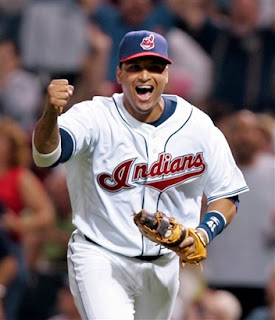
Victor Martinez, moments after completing The Triple PlayAs I mentioned before, I watch this year's team and I think of the boyish camaraderie of the 1997 squad (only this time complemented by the first two guys to both win eighteen games for this club in the same year since 1956), and I feel that old, soaring sensation of hope once again. I look at our fantastic bullpen, our nearly evenly-spread offense, our excellent starting pitching, and the calm, steady leadership of a few core players and I feel tremendous pride for what they have accomplished after coming through such an endless period of offensive futility two months ago. This team may not be completely 100% right now -- if the Indians can ever get The Pronk going full tilt once again in front of Victor Martinez (the team's backbone), then their offense will become a steamroller that no one will want to face -- but then again, it's this club's heart and their belief in themselves that carries them just as much as their individual abilities now, and how can you not fall for a team like that when it comes along?

While living vicariously through a sports team is an inherently selfish exercise, I wish to add here before I conclude that while I may feel personally involved in chasing down a pennant or a title like any devoted fan would, I am ultimately rooting for the city of Cleveland itself. More than anything else, this city needs a winner, and we've waited more than long enough to experience one. As silly as it may sound, I want Cleveland to feel good about itself and to finally be able to shake off all of the ancient snide jokes (lol burning river lol) and declare "we are the champions" once again. No, we're not going to wake up the day after a theoretical World Series victory and suddenly see our troubled city transformed into Utopia On-The-Lake, but the spiritual lift a world championship can give this area is something I've wanted so badly to see for twenty years now (in any damned sport), and only just these past few days is the rest of Cleveland finally beginning to sense what might be at hand.

Get ready, Cleveland: this time, there will be no last minute "choke," and while there are some very daunting obstacles looming ahead after the next week is complete, I sense more resolve than fear from this team. The Cleveland Indians want to win it all as badly as we do, and they're coming after it with everything they've got. Sure, New York is likely going to wind up in our way once again and (let's face it) the Bronx Bombers have had our number all year long, so simply winning a game against them right now would almost feel like a Game 7 win. I think we can do it, and if the Indians can find a way to get around The Pinstriped Ones at last, then I think the World Series will be theirs for the taking, no matter who shows up to represent the National League.

OK. Gotta go: it's Tribe time now.

BONUS TRACKS

For some highlights of this year's team (and even the Rally Pie video shown at the Jake), check out my collection of Indians-related YouTube videos here.

That positively shit-tastic "Let's Go Tribe" song that WTAM uses in its game coverage can be listened to here.

A king's ransom of 2007 Tribe radio highlights, some post-game interviews and even some video footage from spring training can be grabbed or listened to here.

A link to the excellent Diatribe blog.

The Jake on a lazy summer night

Thursday, July 20, 2006

Ultraman Revisited

Ultraman DVD ArtworkMonths after posting in a nostalgic sense about the wonderful world of Ultraman, the powers that be have elected at last to release the original series on DVD ... well, the first twenty episodes, at least.

Let's get the technical stuff out of the way first: the presentation is fairly good throughout, especially with the factors of time and storage considered, though there are some issues with the sound, in particular the dubbed English dialogue switching irritatingly to Japanese at the drop of a hat without automatically triggering the subtitling (I had to manually activate this function on a few occasions). The extras, sadly, are largely inconsequential: a dull, amateur-quality recording of a conversation with the three principal voice actors who dubbed the series for English television, a more informative (though very dry) slideshow walk-through introducing of the monsters featured during this batch of episodes, and finally the English-language opening credits for the show.

As was the case during my marathon week of Johnny Sokko And His Flying Robot on a home-made DVD compilation a few months ago, watching Ultraman Vol. 1 over the last few nights was a rather illuminating experience, as many newer impressions of the show have surfaced since the last time I watched it (which was somewhere around 25 or more years ago). It was also impossible not to contrast the two series as the series wound onwards, and I am pleased to report that Ultraman quickly overpowered Sokko in nearly all fields of comparison.

The most immediate impression I got from watching these DVDs was what a weirdly schizoid show Ultraman could be as it occasionally blended goofball slapstick humor with surprisingly heavy existential plot developments, not to mention an unexpected, not-quite-psychedelic-but-definitely-mid-1960s surreal twist noticeable in the style of the later episodes.

Science Patrol Members Ito, Captain Mura and IrashiDespite some genuinely creepy monsters and set-pieces scattered around the first 20 shows, Ultraman comes off as a lot more overtly kid-aimed than I'd remembered. I realize that this isn't exactly an amazing observation concerning a show that features stunt performers in silly rubber monster suits getting their asses kicked on a weekly basis by another guy in a skin tight silver getup, but bear with me a bit. Unlike Johnny Sokko, whose characters were taciturn and businesslike with only rare occasions where they engaged in comedy, there are times watching Ultraman when you wonder exactly who selects agents for Science Patrol duty, especially if such clods as Ito (an electronics whiz who comes off like a Japanese version of Jerry Lewis), Irashi (a hot-headed dolt who wants to blast everything in sight with his two-handled ray gun), and the obligatory "troublemaking kid character" Hoshino somehow made the grade.

Then again, the whole reason I watched this show as a kid was the monsters, and watching these epic battles between Ultraman and his foes is a massive giggle not altogether different from a pro wrestling match (with some good ol' fashioned sumo moves here and there for color). While Johnny Sokko's Giant Robot fought in pretty much the same clunky way you'd expect a robot to fight, Ultraman was a nimble, graceful, sometimes playful figure in the ring who floated like a butterfly and stung like a bee. I will also add that the carnage is often spread equally by the battling titans, as Ultraman also seems to cause just as much damage to balsawood Nipponese infrastructure as his nemesis in any given battle. It was also surprising to note how quickly most of these fights were resolved: Ultraman was able to dispatch many of his assailants by simply utilizing his badass Specium Ray after a few moments of spirited leaping about and a few strategically-placed karate chops.

Another thing that struck me was that the production values on Ultraman seemed much higher than those of Johnny Sokko in nearly all areas, from the music to the use of location shooting and generally more creative monster design (not only were many of Sokko's adversaries rather cheesy in comparison, but the show's creators gleefully re-used their monsters two and three times over during the show's run).

I'll conclude with what is for me the most interesting difference between the two series: the tone of the shows as a whole. The U.N.I.C.O.R.N. organization were effectively at war with the Gargoyle Gang throughout the run of Johnny Sokko as every single foe faced by the Giant Robot was a stooge of the bad guys. With Ultraman, the enemies are spawned by nuclear accidents, radiation exposure, or just happen across the Earth from the depths of space and time, and not all of them had what could be construed as "evil" intentions. Thus, there are a few episodes of Ultraman that end on a surprisingly melancholy note as the defeated monsters are given a mournful musical sendoff rather than a rousing fanfare of victory.

Monday, May 08, 2006

Baseball's Best: Online


I was in a bit of a Tribe nostalgia mood (or perhaps merely feeling a tad masochistic) a couple of weeks ago, and I wound up watching both of my aging commemorative World Series videotapes over a couple of evenings.

The 1995 series against the Atlanta Braves was certainly the far less painful of the two to watch, since the Tribe was quite simply outmatched on the pitching front from the get-go.

The 1997 series against the Florida Marlins, however, is an entirely different kettle of fish to watch. This time, the times were far more evenly matched and walking into a packed-to-thegills BW-3's to watch Game 7 on that cold late October Sunday night, it looked like we were finally going to get the sports championship that this town has wanted for so long. Of course, it wasn't to be, and perhaps in the worst way possible ... we were one strike away from winning it all in the bottom of that ninth inning.

One. Lousy. Strike.

Thus, instead of becoming one of the the high points of my life as a baseball fan, Game 7 represented instead one of the most excruciating evenings in the history club. Talk about having your heart just ripped out of you. Ugh.

Anyway, while watching the opening set-up montage for the '97 Series, I was shown blips of the preceding, bitterly-fought ALCS battle with the Baltimore Orioles which reawakened my memories of that series, particularly Games 3 and 6, which remain to this day two of my favorite Indians games ever. Wishing for the thousandth time that I'd taped these marathon pitching duels, I started combing the web looking for a way to land copies of these gems for myself.

What I came across instead of way to own these games was a way to watch at least one of them (Game 3) via. streaming video from MLB itself. I also managed to kill the rest of that day with a $3 "day pass" to MLB.com's Baseball's Best library, where a large array of their selected greatest games await you in streaming form (be it audio or video), including that gutwrenching 1997 Game 7 in full. There are also a bunch of "shorts" as well, which combine some highlights with modern interview footage for those who don't feel like watching entire games, or you can pick specific innings to watch, should the mood strike you. Pretty cool stuff, and I've become a bit tempted to subscribe for a month in July or August when the pennant races get going and watch whatever games I please whenever I want.

A quick note: your overall enjoyment of the Baseball's Best selection will be greatly enhanced if you happen to be a fan of the Goddamned Yankees, since they seem to dominate a large part of the offered games on the list. Even if you aren't, however, there are a couple of reccomendations I can pass along in the form of featured perfect games from David Wells and David Cone, both of which manage to transcend being Yankees games and become more about individual achievement. Despite my intense loathing of the Bronx Bombers, I couldn't help but get swept up in the moment as these two guys pulled off the rarest feats in the game (there have only been five of these in my lifetime to date).

Monday, January 30, 2006

Wish Book Scans

Aside from the turkey dinners, afternoon marathons of Godzilla movies, and digging for new toys in the upstairs bedroom drawers, another of the highlights of every Thanksgiving weekend we spent at my Grandma Cooke's in Pennsylvania was digging out that year's Sears Wish Book from the tiny magazine cabinet next to her recliner and then spending literally hours drooling over the new toys. Since my parents would often head out shopping on Black Friday, I'd spend most of Thanksgiving evening creating truly sick-dog huge Christmas lists from all of the provided ideas in these catalogs. Yeah, my chances of getting even half of this stuff on my lists was nonexistent, but hey, I had to try.

Anyway, somewhere out there in 'Netland, some very driven individual (bless his heart) has taken the time and effort to scan and post all 670 pages of Sears' Wish Book For The 1979 Holiday Season on flickr.com, and gazing upon those ancient pages was a powerful, wonderful time warp straight back to my wantonly avaricious child self. Remarkable nostalgia.

For those of you who don't have the time or don't feel like scanning about for an hour, I included links to some of my favorite parts:

* Some fave reading materials of mine from that time period on this page, including Dynamite! and Bananas magazines, and the Charlie Brown Book(s) Of Question And Answers.

* My dad had this electric ball bearing clock halfway down this page. This was cute and cool for about a day or so. After that, it became intolerable since it made so much damn noise. We slept in the room right behind where this thing was set up. At 1:00 A.M. nearly every morning, I was awakened by this thing doing a power dump as the maximum amount of usable marbles (12:59) were all summarily jettisoned from their shelves and rolled into the guts of the damn thing.

* Wee Wonderful Waterfuls!!! Slime!!! Silly Putty!!!

* Oh wow ... they had Bee Gees-themed kiddie turntables and amplifiers?

* Oooo, Spirograph. And Lite-Brite. And that spinning thingie that you dripped paint onto to make wicked cool designs (and made one unholy fun mess if you timed it right). They don't make 'em like this anymore.

* I don't think we had the Winnie The Pooh model, but that bath tub toy in the upper left corner on this page looks awfully damn familiar ...

* Ye gods ... I think half of my old childhood toy box is on this page and that page alone.

* When I was much younger, my brother and I were all about Hot Wheels. We both wanted that beauty service garage, but never got one.

* Ack. The less said about this page, the better.

* Mmm, I lusted after this Iwo Jima playset for years.

* Star Wars toys! Now we're talking! I'd forgotten that this awful, ultralame early Mos Eisley cantina playset even existed (the die-cast metal Star Destroyer was pretty cool, however), but there was much joy in our household when my brother and I scored the Millennium Falcon, the X-wing fighter and the Darth Vader TIE fighter instead.

* Ooo, Nite-Glow.

* Haa, I'd completely forgotten that Sears had their own Atari 2600 clone.

* This was long before I ever owned a computer, but the pages here and here that advertise the Atari 400 Personal Computer System (complete with data tape drive and awful membrane keyboard) are a hoot.

* I never got the 2-XL as seen here, but my sister got the Speak & Spell, and I believe my brother had the Little Professor calculator.

* Oooo, how desperately I wanted a Big Trak or a (ROM The Space Knight, for that matter)? Let me count the ways...

* Merlin!!!! I never had a Quiz Wiz, but oh did I badger my parents for one...

* I had these electronic sports games ... well, (1) (3) and (5) at least!


Ahh, memories. I've said it before, I'll say it again: I love the internet.

Wednesday, January 25, 2006

Johnny Sokko And His Flying Robot

One of the biggest surprise gifts I recieved this past Christmas was a 2 DVD-R set containing the complete run of Johnny Sokko And His Flying Robot: a 1967 Japanese T.V. series that was imported (and substantially re-tooled) for U.S. syndication two years later.

Similar to the previously-discussed Ultraman T.V. series (which was shown back to back with this show on WXON Channel 20 in Detroit during my youth), Johnny Sokko was all about hilariously fake-looking giant monsters attacking Tokyo on a daily basis and getting their rubbery asses kicked in short order by a 100-foot tall Egyptian-looking robot equipped with eye lasers, a flamethrower for a mouth, and rocket-launching fingers. Said robot can also fly at Mach 17 and is controlled by the series' namesake: a pudgy 12-year old kid with a radio-control wristwatch.

Adding an element of secret-agent cool to the proceedings is the "secret war" that represents the story arc of the entire series. You see, these unending monster attacks weren't just random beasts sludging ashore from the depths of the Pacific out of sheer boredom, but instead these were deliberate attacks by the evil Emperor Guillotine from the planet Gargoyle, whose planned takeover of the Earth by way of "Giant Robot" was short-circuited by Johnny Sokko being the first voice heard by the automaton following its accidental activation by an (apparently very low-yield) nuclear explosion at a Gargoyle-run construction facility.

Since Johnny is now the sole controller of the robot, he is quickly persuaded by his new best buddy (and suave secret agent) Jerry Mano to join U.N.I.C.O.R.N., a kind of worldwide police force charged with the security of the Earth against all foes, most notably Guillotine's hired muscle, The Gargoyle Gang (the footsoldiers of whom all resemble Japanese Nazis in Ray-Bans, particularly their initial boss, Spider).

I suppose being a kid and seeing these 26 episodes scattered over a month or so of afternoon T.V. viewing failed to telegraph just how incredibly stupid most of the plots for this series really were, but watching all 26 in a 3-4 day period really drove the point home. Your average Johnny Sokko episode (you can view synopses of all the shows here) pretty much goes like this:

1. A monster attacks something somewhere.

2. Johnny and Jerry are sent to investigate, alone.

3. In a matter of minutes, Johnny and Jerry are captured and summarily threatened a lot by the Gargoyles and their current leader (any one of a mixed bag of cool / extremely annoying characters). Of course, the two are never killed outright (which would be the most immediate way to take Giant Robot out of the equation once for all), but constantly placed in a room with a time bomb ticking away in the corner. The enemies, of course, all chuckle evilly and walk off to another room in order to await the big ka-boom.

4. Johnny and Jerry escape, of course, and the day's monster is unleashed upon Tokyo.

5. Johnny calls in Giant Robot and the final battle is waged (and generally won in very short order).

One key factor to this show being as, well, laughable as it is most of the time has to be due to the near identical nature of the plots from episode to episode, as described above. While I realize a certain amount of fallibility in both organizations is necessary for there to be any kind of tension in the battle between good and evil, the incredible, absolute incompetence of both organizations is just staggering to behold. Funnier still, in light of their apparent complete inabilty to keep a secret or guard any given location with any number of soliders, both sides also display a convenient omniscence in being able to infiltrate the deepest reaches of their enemies' organization at the drop of a hat. If, say, U.N.I.C.O.R.N. hatches a top secret plan to move a new, indestructible metal from Point A to Point B, you can guarantee at least one agent will reveal himself as a Gargoyle member and steal said formula. Bet the house on it. You'll never lose.

Dr. Botanus: the spritual father of Destro, I'm sureDespite these often hare-brained plots, a few of the later episodes in the series managed to reach some startling (and occasionally very creepy) creative heights for a kid-aimed T.V. show, which is rather disappointing since you must wade through so much dreck to get there. The same was true of the characters employed by Guillotine to command his foot soldiers. Spider was dealt with early in the series (in a rather bloodless, yet graphic fashion), leaving the command of the Gargoyle forces to a host of replacements. Yet, for every interesting leader such as the silver-skulled Doctor Botanus, the truly ghoulish Space Mummy or the Gargoyle-controlled robot Torozon (perhaps the only truly worthy opponent faced by Giant Robot during the whole damn series), you have such incredibly inane creations such as Fangor (imagine a cross between William Hung and The Phantom Of The Opera), the unbelievably irritating green gigglemuppet Dr. Engali, or the monster Double-Head (the most hilariously fake monster of them all: Giant Robot very nearly knocks the headpiece off of the costume a few times during their climactic battle).

All that said, it was a hoot to watch this series again through older eyes. I don't know if I could ever watch all of these again in sequence (some were that bad), but there are definitely a handful of standouts that should stand up well to repeat viewings. Here's hoping my friend Dave (who gave me this collection) can come up with the whole run of Ultraman on DVD for this Christmas ...

Thursday, November 03, 2005

Ultraman

Ultraman with Chest Bulb ThingAs you might have inferred from my current user photo, I have recently been on a bit of an Ultraman kick. I have no idea what drove me to start Googling around on Ultraman and seeing what was out there a couple of weeks ago, but I've been a total blast revisiting one of my favorite T.V. shows from my childhood.

Waaayy back when I was a kid, my family would spend most Thanksgiving holidays at my grandmother's house in the unfortunately-named burg of Beaver, Pennsylvania. Back in those unimaginably quaint pre-cable T.V. days, the Greater Pittsburgh area didn't offer an awful lot of choice in the UHF band, so WOR TV-9 out of New York City was beamed in to give residents a bit more of a viewing selection than just the three networks.

Normally, this quirk of programming wouldn't have meant anything to me at all, save that from 1976 to 1985, WOR had a tradition of showing nothing but Godzilla movies from morning to evening on the day after Thanksgiving (Turkey Day itself was filled out by sundry King Kong flicks). To a 7-9 year old kid, this was even better than saturday morning cartoons: watching 400 foot tall radioactive dinosaurs knocking each other around like professional wrestlers was more than enough to drive me to wild heights of glee.

God bless WOR TV-9
However, being that there was only one T.V. in the household, and that my monster movie marathon was always on at the same time as the day's lineup of college football, my relatives would always reach wild depths of exasperation with me and wage lengthy battles over who got to watch what.

Anyway, from these humble beginnings came my childhood love of nearly all movies in this ilk, no matter how stupid or hokey (not to mention the attendant hilariously wound-up Crazy Eddie commercials). Imagine my delight, therefore, when I discovered one day that a half-hour T.V. show featuring a whole new cast of monsters and badly-dubbed heroes was available for viewing on WXON (Channel 20) in Detroit. And this came my introduction to Ultraman.

The Science Patrol In Action!The story of the original Ultraman series (not to be confused with the seemingly several dozen other series that followed) goes like this: this guy Hyata (seen standing to the right) is a member of the Science Patrol, who function kind of like the X-Files unit of the Japanese CIA, if you will. Members of this team wore these really awful loud orange suits with red ties, button-down lapels, and modded white motorcycle helmets. They also used ray guns and flew around in a kinda hybrid airplane/rocketship that launched from the top of their headquarters building (which itself was the size of a city hospital).

I should also add, by the way, that this series also had one of the fuckin' grooviest theme songs ever.

Anyway, back to the story: while flying about in outer space looking for UFOs, Hyata's rocketship collided with that of Ultraman (an advanced superbeing from neubula M78). The collision between the ships kills poor Hyata and Ultraman, feeling really bad about this, decides to make amends by resurrecting the Science Patrol officer and lending him his life force (in effect, becoming a kind of symbiote with him). Ultraman technically ceases to exist as he inhabits Hyata's body, but he can re-emerge to save the day whenever Hyata whips out his Beta Capsule in times of dire need. I realize this sounds kinda wrong, but just bear with me, here.

Now, there was a catch to this deal: Ultraman, being an alien being, doesn't adapt too well to the Earth's atmosphere and as a result can only fight giant monsters for a few minutes before he starts to freak out. Well, O.K., he doesn't so much "flip out" as a little light indicator on his chest starts flashing insistently which means "uh oh, hurry it up, pal" and lends an element of danger into his fights with other guys in rubber suits.

Ultraman Getting Ready To Kick Some AssOf course, Hyata and Ultraman being one and the same has to remain a secret. Thus, Hyata becomes a kind of Clark Kent figure at times, having to slip away from the other members of the Science Patrol in order to turn into Ultraman and kick some monster ass before all of the balsa wood sets could be completely flattened by the "guest" monster.

It wasn't long before WXON added another monster-themed show directly after Ultraman, and that was Johnny Sokko And His Flying Robot, which may have shared a lot of very similar elements to its setup, but never was as outright cool as Ultraman (though it had its moments here and there).

As a final note: people currently living in Florida and complaining about the amount of hurricanes blowing through over the last two or three years are a bunch of pansy whiners. Going by the established histories set forth in Godzilla, Johnny Sokko, Ultraman and Gamera, it's glaringly obvious that during the 1960s, the major cities, industrial centers, and military forces of Japan were ravaged every week by enormous, ravenous monsters from the depths of the Pacific (or deep space in some cases). Despite these contant incursions, however, the citizens of Japan seemed to do pretty well for themselves, all things considered. As usual, we Americans have no idea just how good we have it here.

Thursday, May 19, 2005

The Sith Hits The Fan

WARNING: For anyone reading this, buried in these incoherent ramblings somewhere are some thoughts on Revenge Of The Sith. These thoughts are laced with what many call "spoilers," so if you haven't seen the movie yet, you might want to wait until you have before reading this.

Star Wars...no, not Episode IV. Just Star Wars, thank you very muchIt's a bit hard to remember now being nearly thirty years ago, but I think I saw Star Wars somewhere around a month after it was released. I'm pretty sure I was out of school at the time on those glorious summer vacations that seemed to last an eternity when you're eight years old, so we'll say June 1977 and leave it at that. My parents had gone out the night before and seen the movie with their friends. The next day, my mother and my "Aunt Marilyn" (her best friend at the time) took my brother and I and Marilyn's son Paul to see it: which I suppose indicated that they were pretty into it (or at least felt that it might keep us out of trouble for an afternoon). I remember very little about the experience, save for a couple of key iconic parts and telling my dad later that evening to his amusement that I really dug the Empire (which at that time meant Darth Vader).

To this day, I think we only saw Star Wars once in the theater, though it wouldn't surprise me to discover it was more than that, since theatrical movies back then played for months instead of weeks at a time. The movie certainly had a profound influence on my interests as a kid, since from that point onwards, just about any movie or T.V. show that had anything to do with space adventure was on my "must see" list, whether it was network shows like Battlestar Galactica and Buck Rogers In The 25th Century, or movies like The Black Hole and Battle Beyond The Stars.

The Empire Strikes Back: hello, geekdomWhen The Empire Strikes Back was released in 1980, my best friend at the time (Rob VanNortwick) and his father took me to see the Saturday matinee showing on Day 2. As with Star Wars, I am unsure if we saw this more than once at the cinema, though I'm a little more sure that we did not. Not that it mattered, really, since it was this movie that officially made a full-blown Star Wars geek out of me. The expansion of the scale involved in the movie probably had the most to do with it, with new characters and planets and a much longer view of the battle between good and evil (suddenly Darth Vader was not The Bad Guy, but a cog in The True Bad Guy's machine, et cetera). Sure, I had a lot of the toys and had read some of the rather silly Marvel comic books by then, but I think I was still too young before 1980 to really achieve that slobbering degree of loyalty that separates the geeks from the casual fans. After Empire came out, I found myself suddenly compelled to spend stupid amounts of allowance money at Gray Drug across 12 Mile Road every week collecting all of the trading cards, novelizations, magazines, and making-of/behind the scenes books I could lay my hands on.

It goes without saying that by the time Return Of The Jedi came out in 1983, I had to be one of the first to see it (nevermind that I'd already swallowed the novelization and comic book adaptations whole by the time it was released). Jedi, incidentally, also started up the "opening day" tradition of seeing Star Wars movies for me, which has lasted to this day. By now, I had fallen in with a cadre of fellow Lucas geeks in my junior high school years, and we made a group event out of opening day by somehow wrangling all of our parents to let us catch a show right smack in the middle of a school week.

Return Of The Jedi: the very apex of my childhoodMay 25, 1983. Ah, this was a day to be remembered: about a half-dozen of us made our way to the Americana Theater (we had to have been dropped off and picked up again by somebody's parents...though I cannot at this time recall whose) after being let out of a particularly endless day at Alice J. Birney middle school. This was the pre-multiplex days, and the Americana had two screens housed in a building as large as most of the modern facilities in use today. Even considering how freaking huge the auditorium was, the line outside the theater was the longest I had ever seen for a film up to that point, and peppered with other kids from my school. After what felt like an eternity, we got inside and watched that fucker in 70mm Dolby Stereo as part of a joyously racuous audience (lots of lusty cheers and boos as the main characters appeared on screen) and had a whale of a time. Nevermind that dozens of chattering Ewoks and a handful of goofball monsters in Jabba's court made Jedi at times feel like something out of The Muppet Show, this was the capper event of my pre-adolescent life.

Save for multiple repeat viewings of the trilogy throughout high school after moving to Ohio and falling in with a smaller (though no less devoted) group of fellow superfans, that was pretty much the end of Star Wars being an active part of my life. Save for the VHS releases (which took years to happen back then), Star Wars was largely "a Michigan thing" as I had outgrown the toys and trading cards end of the whole enterprise by the end of 1983 and was finally starting to move on to other special interests. For about thirteen years after that, life went on, and while I would occasionally watch or riff on the "Holy Trilogy" with friends when the occasion warranted (and pick up the remastered widescreen versions like a good fanbitch), the thought of ever seeing Parts 1-3 or 7-9 actually happen never really crossed my mind.

Ah, but then George Lucas decided to test the waters for a new trilogy at long last by releasing the original films in theaters once again in early 1997. While the chance to see these movies on a big screen for the first time since I was a kid certainly would have sold me on that point alone, Lucas sweetened the deal by adding all kinds of enhanced visuals using modern computer animation effects to flesh out and spiff up scenes that were out of adequate technological reach at the time of the original productions. A few friends and I took in each re-release on opening night, dutifully keeping with tradition, and while some of the new CG work left me a bit cold (and frankly distracted at times), it was certainly an interesting experience, and it raised our expectations over what to expect in the future...at least in a visual sense.

Star Wars I: The Phantom ClusterfuckBy the time The Phantom Menace (the first of 3 prequels to the original series and set some four decades before the events of the original Star Wars film) finally appeared to incredible anticipation (and expectations) in 1999, I had made the fatal mistake of expecting to be as blown away as I was when I first saw the original films as a kid. But something was different about this film...I wasn't anywhere near as engaged as I was beforehand. Even though I did wind up seeing Phantom two or three times at the theater, it was an empty experience that multiple viewings couldn't improve. It felt like this movie was aimed squarely at kids my niece's age, which made me wonder for the first time if the original films weren't. Was this what watching the original Star Wars felt like to a thirty year old in 1977? The younger generation sure seemed to eat it up, but I was having real problems accepting what I was seeing, no matter how amazingly snazzy some of it looked.

Over the years, I've come to think of The Phantom Menace as being in the same league as Indiana Jones And The Temple Of Doom in that during both films the first half is fucking excruciating to sit through, while the second half has enough extraneous activity onscreen to keep you interested...yet both ultimately fail to wipe away that agony incurred during the first hour.

Star Wars II: Electric BoogalooAttack Of The Clones followed to my far-diminished expectations in 2002, and (if nothing else) has stood up better over time than The Phantom Menace, though it was occasionally just as arduous to sit through. At least in this case the pain was spread out equally over the running time instead of during the opening hour. Jesus, I'm not trying to imply here that the original trilogy was on par with Masterpiece Theater, but the acting in these films seems so incredibly wooden it's staggering (which I'm quite certain is a by-product of acting to green screens and doing first-takes whenever possible). At least the "good parts" of Clones packed enough thrills to make the godawful "romance" scenes bearable, and the CGI Yoda actually looked like Yoda (and not like a doddering, post-chemo Cookie Monster like in Episode 1).

So now, at long last, we come to Revenge Of The Sith, ostensibly the very last of the Star Wars movies (though I believe that about as much as I believe in the Easter Bunny), and the one that ties together the prequels with the original classic trilogy. Sith takes a pretty tall order on the latter behalf, and I guess in that department it came off as good as can be expected: with this movie, it's not so much the surprises (though there were a couple) as the way things come together in the end that are meant to provide entertainment to longtime fans.

Like good little geeks, Sarah and I went over to the fuckin' mobbed local Regal multiplex for the midnight showing of Sith last night. Despite the scary amount of people present for this thing (five showings on five screens - all sold out) the crowd was thankfully pretty well-behaved during the film. The only real jerk in our vicinity was The Expert, as I refer to him. The Expert is that guy who knows everything about the film going into it and makes a show of explaining every cameo, spaceship and plot development to his group of buddies seated around him. Of course, The Expert wound up sitting just behind my right shoulder, but luckily for me he was drowned out most of the time by the sound system. Hooray.

O.K., let's talk movie.

Holding Sith up to the rather less-than-amazing standards of the last two movies, I'd say it was easily the best of the three, though it's certainly not without it's share of problems, many of which are the same issues discussed above minus the overtly kiddie angle (this is pretty violent going at times, particularly General Grievous: flop fopwhen Anakin starts to sizzle like an overcooked burger). Even dependable Chancellor Palpatine starts to grate on the nerves a bit after his unveiling as Darth Sidious (oh please, like you really didn't know). Immediately after this unveiling, Palpatine switches over to high camp mode -- a near-comical slide into Scooby-Doo-style overacting which worked in 1983 when you didn't know The Emperor from Adam but feels very "off " when you're used to how silky smooth evil Palpatine was without lots of latex makeup and contact lenses on. The movie's other big meanie, General Grievous, is by name alone the single lamest villain idea we've seen from Lucas yet. Watching him during the course of the movie, Greivous is hard to take seriously as a threat of any kind -- he spends most of his time castigating droid underlings in the manner of an asthmatic Montgomery Burns while stalking around looking like some kind of biomechanical toothpaste dispenser.

In the "plus" department, though, I have to admit I found a lot of the "droid soldier" humor to be a scream ... but then I am a sucker for throwaway background jokes like these. There were lightsaber fights galore throughout, with Mace Windu vs Darth Sidious a real highlight as well as The Mother Of All Lightsaber Battles in the final third of the movie. During said clash, Obi-Wan Kenobi's anguish before and during the matchup was pretty convincingly portrayed (Ewan MacGregor has long been one of the bright points in the prequels, acting-wise). Perhaps the most satisfying plot surprise in the film for me was the truly diabolical "Order 66," which definitely belongs on Palpatine's Greatest Hits collection of anticipatory chess moves.

Crawwwling throooouuugh my skiiiinEven more remarkable about Revenge Of The Sith is that I actually liked the character of Anakin Skywalker. For the first time in this new trilogy, the central character in all of this silly geekery comes off believably as a person and makes for a fittingly noble Jedi Knight...well, at least for the first half of the movie, anyway. After a certain plot point is reached, poor Anakin reverts back to vintage Clones form as the petulant, bratty sulking teenager you want to smack upside the head after throwing his Linkin Park records in the trashbin. And, I'm sorry, but Anakin/Vader's "evil" glare -- tilting his head down while glowering at the camera like Alex in A Clockwork Orange -- is just not very convincing.

So, that's that. We have come full circle at last. The credits roll after the storylines merge -- Luke and Leia are shuttled away to live in seclusion on separate worlds, Yoda huffles off to Shuffalo, Jar Jar Binks walks by the camera without saying a single word (woo!), and the familiar black armored figure of Darth Vader watches from the bridge of a two-headed proto-Star Destroyer as the framework for the Death Star is being set up (wow, these took longer to build than I thought) while the Emperor and a young Grand Moff Tarkin hover around nearby.

The rube and the city slicker

I guess in a sick way I am grateful for the existence of these prequels, though I certainly think to myself after seeing the last of them that sometimes it's better for a story to simply say "This is The Bad Guy. Why? Because, that's why!" and leave it at that. If there is one single problematic thread running throughout the entire new trilogy, it's having to accept supreme intergalactic badass Darth Vader as a precociously cute ten-year old kid running around yelling "yippie!" and then seeimg him as a terminally annoying and bitchy teenager ... not to mention unbelievably, incredibly, and galactically stupid (not to mention gullible) when it counted the most. It's very difficult to reconcile this backstory with the calculating and precise Vader we came to know during the orginal trilogy: a figure that frequently force-choked incompetent officers to death, tortured and froze Han Solo alive just for the hell of it and abetted in the annihilation of an entire planet for crissakes. Realizing that all of this came on because Vader really misses mom (and/or wanted to make his secret wife happy and secure) just sounds so damn silly...

NP Star Wars Episode III - Revenge Of The Sith Soundtrack (surprise surprise)

The Cosby kids, a robot, and the family dog